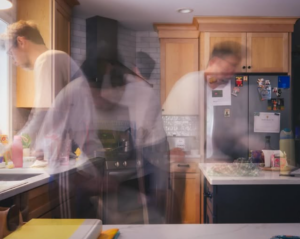
A photo of someone cleaning their kitchen. | Photo from @chazfremont on Instagram
March 11, 2026 | Belen Ponce Leal | Lifestyle Editor
With the temperature outside slowly getting warmer and the need to go outside wearing layers of clothing dwindling, it’s that time of the year when we shake off the cobwebs of our dorm rooms to begin spring cleaning. As someone with a tight schedule, it has been a bit exhausting to think about how much of a mess my living space is. I still have a Christmas tree up. Still, the warmth of the weather and the sunlight poking through the clouds are good motivators to help at least think about spring cleaning.Ìý
One of the earliest references to cleaning during springtime is the Jewish tradition of Passover, which is still observed every year in March or April. During this event, all pieces of chametz (leavened bread) would be disposed of in the time leading up to the holiday. This is symbolic of an event known as the Exodus, which was when Moses helped the Israelites escape Egyptian slavery with God’s help. The removal of the bread symbolizes them being in such a haste that they weren’t able to wait for their bread to come before they had to make their journey.Ìý
In the Catholic faith, there is a similar tradition where, on Maundy Thursday, people will clean up the altars in churches. Maundy Thursday is a day that celebrates the last supper Jesus had with his disciples. Similar to Passover, this day happens in the months of March or April.Ìý
Nowruz, which is the Iranian or Persian New Year’s Day, has a tradition known as khÄ�ne-takÄ�nÄ« or “shaking down the house.â€� This involves washing blankets, clothes and textiles in preparation for the new year.Ìý
Similarly, cleaning is very important for the Lunar New Year. In Chinese culture, it is known as “sweeping the dust.â€� They deep-clean their homes in order to rid them of bad luck and misfortune. Tidying the place up is said to bring good luck for the new year.Ìý
Spring is seen throughout the world as a time of renewal and growth, where life begins anew after the coldness of the winter months. As the leaves begin to form on the trees and flowers start to pop out of the grass, people tend to feel the need to replicate the “shinyâ€� environment within their living space. It’s a common experience to feel somewhat tired during the cold months, as the “deadâ€� appearance of the world makes it hard to get motivated.Ìý
Before modern technology, i.e., heating and insulation, homes that were in colder places were sealed up to prevent cold air from coming inside. This generated dust and soot that would build up. Once it began to get warmer, it was time to air out the home and clean up the mess that people literally could not clean during winter.Ìý
However, even in modern times, it is still wise to spring clean. Despite insulation, dust and allergens can still build up in the home over time, especially when it’s dark. It would be wise to try to clean out those hidden spots behind tables and shelves. Cleaning can also boost mental health. As someone who enjoys collecting things and is also a bit lazy, living in a cluttered area can be stressful. Coming home to a messy room is never enjoyable. Making the environment welcoming, fresh and comfortable will not only be more enjoyable, but also helpful to the mind Ìý Ìý Ìý at a time when finals are coming up.Ìý
A photo of a bowl of gourmet chocolates. | Photo from @chocolatelover_rz on Instagram
March 11, 2026 | Belen Ponce Leal | Lifestyle Editor
I believe there is no sweeter taste than that of chocolate. With a sweet, creamy and enjoyable taste as well as a lovely appearance, it is a candy that is normally a person’s best friend or guilty pleasure. Not only does chocolate have a rich taste, but it also has an even richer history.
Cacao trees, which are native to Central and South America, are the trees that produce the fruit from which chocolate is made. They produce pods with each having around 40 cacao beans that are dried out and roasted to become cocoa beans.
The Olmec people are believed to be the first group to be curious to know what these beans tasted like. According to Hayes Lavis, a cultural arts curator for the National Museum of the American Indian, there are ancient Olmec pots that were found with traces of a stimulant known as theobromine, which is found in chocolate and tea. It is believed that the Olmecs used cacao beans to create a drink, which was likely savory rather than sweet.
The Olmecs then passed their cacao expertise to the Mayans, who mixed the beans with maize and water. It could then be adjusted with allspice, vanilla and ear flower. The latter is described to have a spicy flavor similar to black pepper. This mixture was then poured from a height to create a foaming effect on the drink.
The Aztecs would not only make a similar beverage, but also add chili powder and achiote to make the drink have a reddish hue. They would also boil it occasionally to create a rough draft of hot chocolate. The Aztecs called their chocolate xocolatl (shoh-koh-LA’-tul) and it was typically an upper-class privilege to be able to have it, though those of lower classes would enjoy it on special occasions.
The drink was not only a treat to the Mayans and the Aztecs, but also held a lot of significance to them. They believed the beans to be a gift from the gods and would drink xocolatl often for religious ceremonies.
Although there is a debate about when Europeans got their hands on this delicacy, it is widely believed that it arrived in Spain first, which, when considering how much of the world they colonized, makes sense. By the late 1500s, the Spanish court was completely captivated by chocolate and began importing it to other European countries in the area. With such high demand for these cocoa beans, chocolate plantations were created with slaves made to work on them. Europeans also experimented with the ingredients, using cane sugar and cinnamon to add a more sugary taste instead of the savory ones the Aztecs made.
Chocolate would eventually come to the American colonies, arriving from a Spanish ship in 1641 to Florida, with the first chocolate house opening in Boston. Fun fact: During the Revolutionary War, chocolate was given to soldiers as a form of payment instead of money. Nowadays, chocolate is mass-manufactured and sold around the world. However, there are still some shops that handmake chocolate to ensure their products are much richer than the typical Hershey’s bar bought at the store.
Admittedly, I’ve probably eaten way too much of it throughout my life, but I always thought that the history of this delicacy was fascinating in the way that it really transformed throughout the centuries to become what it is today. As a fun little fact about myself, I actually tried xocolatl in the 7th grade as part of a unit about the history of chocolate. I have to say … I did not enjoy it. However, it’s still a pretty cool fact knowing that I’ve tried ancient chocolate.
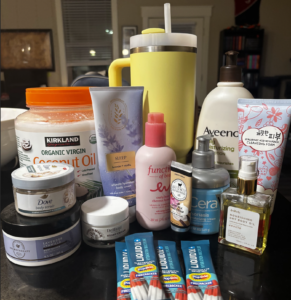
A partial collection of the author’s preferred products to manage dry skin. | Photo by Jaylin Emond-Hardin
March 4, 2026 |ÌýJaylin Emond-Hardin | Entertainment Editor
In the winter, dry skin affects approximately 70% of the population. This is due to a plethora of reasons — skin conditions or the low humidity that comes with the season being two of the main ones — and can be cracked, red, flaky and just plain irritating.
As someone with chronically dry skin — having both eczema and psoriasis — it always gets worse in the winter months. When temperatures drop, the air simply cannot hold as much water vapor, which lowers humidity levels and pulls moisture from the skin. For example, air at 77 F can hold nearly three times more moisture than air at 32 F. That sharp decrease in the air’s moisture-holding capacity is one of the main reasons skin feels tighter, drier and more irritated in colder weather.
Of course, when skin dries out like this, solutions become essential — and after 22 years of managing it myself, I’ve learned what truly works. Below are the most effective, winter-tested strategies I rely on to keep dryness under control.
Skin — The epidermis layer of the skin is the most obvious when it comes to dryness. We feel its dryness in the form of cracked, flaky layers. To help repair this layer, it needs moisture put back into it — more than just a shower can give.Ìý
Lotion is usually the best when it comes to returning this component, although body oil is another great way to moisturize. I swear by Aveeno lotion for the whole body, although any of Bath and Body Works’ lotions with shea or cocoa butter keep skin both moisturized and smelling absolutely divine. For the face, anything with hyaluronic acid, sunscreen or goat’s milk is ideal, especially when there’s a combination of any of the three. Having protection from ultraviolet rays and the additional moisture helps prevent scaling and flaking.
While in the shower, gentler soaps and body scrubs can remove the dry scales without damaging the layer underneath. Rice-based formulas are the gentlest and are one of the best options, and don’t clog the pores when adding that moisture back into the skin.
The lips are another part that usually becomes especially dry and chapped due to their constant exposure to the cold air. Most traditional chapsticks continuously dry the lips out because of the menthol in them — part of their design to keep consumers using them — and have artificial fragrances and dyes. Because of these factors, I typically prefer to use lip oil or Vaseline. They trap moisture in and guard against the winter elements.
Applying lotion or oil immediately after a shower is one of the best ways to lock moisture into the skin, as well, especially when it comes to replacing oils lost in the shower.
Hair — Just like skin in the winter, hair dries out as well, typically losing shine, volume and strength. When moisture is stripped, hair follicles lose important oils that not only protect it, but also keep it looking healthy. The scalp also dries out, which leads to dry, flaky buildup.
To combat this, I use coconut oil on my scalp and rosemary oil on my actual hair follicles. I’ve found I’ve preferred the brand Venrock’s rosemary oil the best, due to its subtle mint undertones and the fact that it doesn’t drip down my face when I put it in my hair. It’s also specifically formulated for curly hair, which means it helps reduce frizz.Ìý
When it comes to coconut oil, organic and food-grade is the best. Typically, cosmetic-grade oil isn’t as refined as food-grade oil and contains other chemicals and scents, which means it isn’t as pure or natural, and can strip the hair further of those much-needed oils. I tend to leave coconut oil in all day when I’m home with nothing to do, and keep my hair tied up in a t-shirt so I don’t get the oil all over my clothes and furniture.Ìý
Leave-in conditioner immediately after rinsing regular conditioner is also a great strategy, as it offers long-term hydration and damage protection. I know my hair is always softest when I use leave-in conditioner, and it reduces breakage and split ends that are synonymous with winter-dry hair.Ìý
Diet — Diet is one of the biggest factors when it comes to dry skin. Proper hydration can mean the difference between dry and healthy skin and hair and lips; meanwhile, eating water-rich foods can assist the skin’s ability to retain moisture. Cucumbers, watermelon and strawberries are some of the best sources of water that come with essential nutrients like vitamin K, vitamin C and vitamin A.Ìý
Drinking plenty of water keeps the skin’s barrier firm and hydrated, which works to prevent scaling and flaking. Electrolytes are important for moving fluids through the body’s cells, so making sure plenty are consumed daily will help with the skin’s ability to retain moisture. Salt helps add electrolytes back into the body, though plain salt water may not be the first choice for many people. In those cases, electrolyte drink mixes such as Liquid I.V. Hydration Multiplier offer a more palatable alternative, combining sodium, glucose and essential vitamins to support hydration in a more flavorful form. The rocket pop flavor is top-tier; with the right amount of ice, it tastes like drinking a melted rocket pop.
Sufferers of dry skin, have heart. Winter will soon be over and humidity will improve, which means dry, scaly and flaky skin will soon be swapped for peeling sunburns. Making sure the moisturizer has sunscreen will help reduce the chances of sunburns, as will keeping the skin hydrated and happy.
March 4, 2026 | ÌýBelen Ponce Leal | Lifestyle Editor
I remember sitting in the backseat of my parents’ car with my older sister. We had this circular metal thing that, when a CD was placed inside, we could plug in some headphones and listen to the songs that were on that disc. We shared headphones and listened to whatever we had available to us, my favorite being the soundtrack to a telenovela called “Rebelde.â€� Aside from my musical taste at the time, we also had a lot of DVD movies around the house. Every year, the collection would slowly get bigger. I got cartoons, my mom got comedy movies, my sister got the annual trendy flicks and my dad got those old cowboy films.Ìý
Then, throughout my adolescence, media slowly transitioned from physical discs to streaming services and subscriptions that wanted credit card information. It was kind of nice in the sense that we no longer had to make space for all the movies and music we wanted to collectÌý and available on our televisions, laptops and phones. However, convenience isn’t always a good thing — especially when things can be taken away from the consumer at any time.Ìý
Generation Z, which I am a part of, has been part of a movement where many of us are gravitating towards physical media instead of digital. According to an article from the Los Angeles Times, physical media sales dropped 9% in 2025, which is much less than the reported over 20% drops that happened in 2023 and 2024. DVDs and Blu-rays have been a big purchasing point with many Gen Z consumers, which drives business for video rental stores. This trend has been a curious rabbit hole to discover and understand the reason for this remembrance of a want for physical media.Ìý
Cognitive Overload —Streaming services can be really nice to have, yet they don’t come without their negatives. Subscription-based platforms can vary in price, with the most expensive having more options. However, the infinite choice of all the available entertainment can be enticing. There are so many options and only a one-time monthly payment that could be the same price as buying one movie. So what could be a possible disadvantage?Ìý
With being able to have access to a large collection of movies and television shows online, it can lead to choice paralysis. Think of it as overloading the brain — there are so many options that it makes it impossible to choose something to watch. The YouTube channel Fuzz Culture said it best: “You open an app for a dopamine hit, and you end up doing mental admin work. You pick up your phone, scroll for 20 minutes, pick nothing and still end up drained.â€�Ìý
In comparison, when people would go to stores and pick out a movie to buy, it was a much smoother process. Someone looked through the giant shelves of movies, handpicking them and making the process much more personal since it was a physical decision to grab it out of all the others. The choice to watch it came when it was purchased, and it was much more likely to be watched after going home.Ìý
The emotional side — There is a sort of personal attachment one feels when purchasing and owning the physical copy of a form of media, whether it be art, music, books or movies. My mom always used to say that she could learn a lot about a person by their collection of cassette tapes and CDs.Ìý
There is also a nostalgia element in place here. There’s a sort of indie feel to a lot of stores that sell older forms of media such as vinyls, cassette tapes, CDs and DVDs. Many stores have this feeling to them, a cozy environment that brings a casual hangout vibe to the place. These types of places are a sought-after location for many post-pandemic people who need new communities. Bookstores, for example, are a good place to go because they are not only low-cost most of the time, but they also tend to have places to sit and gather.Ìý
However, it is much more than a simple trend Generation Z is following. We as humans bond with what we can touch. It’s intimate and tells a story about the person who owns these forms of media. Personally, there’s no greater smell than that of a freshly bought book or a video game disc. Being able to physically turn the pages of my copy of “Jane Eyreâ€� or insert my copy of “Sourâ€� by Oliva Rodrigo into my car provides me a sense of independence that I don’t have to rely on some subscription based platform to have access.Ìý
Unreliability of digital media —Many users of subscription services know the pain of realizing that the show or movie they enjoyed watching was removed from the platform without anything they can do. The streaming service can, at any time, remove something from the platform for many reasons. Usually, there is a license they have to get from producers or distributors of the movie or show. There’s some sort of money that both parties get from it, and should the content not perform well enough on the service, or even if they just don’t feel like having it there anymore, the movie or show gets removed.
The Los Angeles Times interviewed a woman named Lauren about her decision to buy physical copies of movies. She responded by saying, “If something gets deleted off an online platform, I will still be able to watch it because I have a physical copy. … It feels really precious to be able to own things physically and not be at the mercy of studios’ financial decisions.’�
It isn’t just streaming services that cause issues with digital media, though; the gaming industry has been having a big issue with digital games. In March of 2024, the servers for a popular racing game, “The Crew,â€� went dark and made all copies of the game, both physical and digital, completely unplayable. Two owners of the game sued Ubisoft, the publisher of that game, because they purchased the product believing that it gave them unlimited access to it. However, Ubisoft has gone on record saying that purchasing a game doesn’t give the buyer ownership rights to it. It is only a “limited licence to access the game.â€�Ìý
This situation then started a whole movement known as “Stop Killing Games.â€� This movement, launched by YouTuber Ross Scott, aims to “challenge the legality of publishers destroying video games they have sold to customers.â€�Ìý
When video games are sold, they aren’t given a clear label or “expiration date.â€� They are sold the same way that physical game copies have always been sold, without a clear notice about the potential for the game to eventually stop working. This movement was based in Europe and ended up getting over 1.3 million signatures on their petition, which forced the issue to be considered by the European Union.Ìý
The current state of Stop Killing Games is that it is establishing two official non-governmental organizations, with one based in the European Union and another in the United States. While Scott has decided to mostly let Mortiz Katzner, a political strategist, take the lead of the initiative going forward, he will still be involved. Scott also acknowledges that he isn’t sure how much change the groups that are being created will bring, especially in the U.S. market, but he is optimistic about at least raising awareness of this issue.Ìý
Gen Z is a very nostalgia-driven community. All of us enjoy reminiscing about our childhoods and are often very anti-capitalist. Collecting physical media can be seen as much more than us simply following a trend — it is us as a generation reclaiming our individuality. Considering that we are in an area where digital media is not only unstable and inconsistent across platforms, there is also so much generative AI and brain-rot sort of entertainment that can really be mentally exhausting. So, I will be saving up for a DVD player and will be going home to collect all of the old Barbie movies sitting in the garage of my mom’s house.Ìý
French fries are one of the most beloved sides to many fast food dishes. Most burgers come with a full side of them, chicken baskets come stacked with them and even fish have “chipsâ€� to adorn the main dish. Fries come in all sorts of shapes and sizes: some curly, some salty, some spicy or just plain.Ìý
Growing up, both of my parents worked at a potato factory and would often bring bags of fries home whenever they would have extras. I watched my mom dip them in a pot of boiling oil, and I was so hungry that I would usually burn my fingers while trying to grab them. As an adult with an air fryer and somewhat more patience, I recently made them while my husband was making some chicken tenders to go with them and started wondering where they came from.Ìý
There seems to be a bit of a custody battle between two countries that claim to be the creator of fries. The name “French friesâ€� implies that they originated in France. According to cookbooks from the country, they mention that potatoes have been fried as early as the 1700s, but probably didn’t look anything like the fries we imagine today. Some say that the side dish was originally a snack sold by street vendors as a sort of street food. If anyone has seen those videos of street food on TikTok, it is believed to be made similarly.Ìý
However, fries were recently believed to be tied to Belgium as their “birthplace.â€� According to some historians, fries were invented in the winter of 1680 when the citizens of Namur, who had a knack for loving fish, needed to find something else to eat during the time when the lake froze over. Since they no longer had fish to cut up, they decided to use potatoes instead. They cut them into long skinny pieces, fried them up and created French fries as a sort of struggle food. While others argue about the legitimacy of this “fry lore,â€� Belgium has been firm in its belief that it is the parents of this famous side dish that we Americans can’t get enough of.Ìý
Yet, there could be another reason why these two countries specifically claim to have created fries. A Belgian researcher named Pierre Lecercq did extensive research trying to figure out where fries came from. He discovered that a cook named Herr Krieger, who was trained in Paris, was traveling town to town in Belgium in the early 1800s. He sold fried potatoes that were sliced, which he described as Paris-style fried potatoes. Supposedly, he cut them into slices because it made it easier to cook them.Ìý
French fries have been stuck in a custody battle for a few years now, and in the end, where they came from doesn’t really matter. After all, I couldn’t care less whether they come from Belgium or France. I personally enjoy the thought of them being made by a trained French cook, but sold around towns in Belgium. Yet, as long as the fries are crunchy with some ketchup or fry sauce, I will enthusiastically eat them no matter where they’re from. Except In-N-Out.Ìý
Feb. 18, 2026 | Belen Ponce Leal | Lifestyle EditorThose in relationships are often trying to find ways to make their partners feel appreciated. Ranging from pricey gifts to dates to even traveling together, everyone tries to find a way to make their significant other feel special. However, due to everything constantly changing and getting more expensive, I thought it would be a good idea to list some romantic gestures that any partner would enjoy receiving.Ìý
Cleaning/Organizing — Something I think is highly appreciated in a relationship, especially when the couple lives together, is keeping the home a bit more organized. Tidying up the living space is nice and makes one less thing for a partner to worry about. If wanting to be more specific, try to do something that has been actively avoided for a while. Maybe there’s a junk drawer that needs to be cleaned out. The closet might need to be reorganized, or the car could use some vacuuming.Ìý
Meaningful — If wanting to up the romance and exercise the brain a bit more, writing something meaningful for a partner is always a good idea. Whether it be a poem, a love letter or a small note, something handwritten can mean much more than a cheap card bought at the store. If more of a visual kind of person, creating a painting or a sketch for a partner would be incredibly sweet. A kind gesture to do for someone would be to create a photo album for them. Go down memory lane and fill it with photos, tickets to concerts, movie posters, handwritten notes or anything that has meaning. Similarly, a person can create a memory box and fill it with all the same items.Ìý
Audio-related — If both are music lovers, making a custom playlist for each other would be a thoughtful gift, especially if it’s songs that remind the person of their partner. It can also be a bunch of songs that they would like to play in the car. If wanting to be more playful, recording voice memos for a significant other can be both more meaningful and potentially funny, whether it be telling them how much they mean to the other or saying that they saw a weirdly shaped tree.Ìý
Activities —There are several things couples can do. Cooking dinner together or as a surprise for a partner when they come home from work is always fun and appreciated. Something my husband and I love doing together are couple’s quizzes. They are popular on Instagram and TikTok, but don’t necessarily have to be couple-related. There are some quizzes that can be done on YouTube about various subjects, whether it be Disney movies or who knows the most Bad Bunny songs. There are also many two-player games that couples like to play. Some that come to mind are It Takes Two, Overcooked!, A Way Out and Split Fiction.Ìý
Expensive gifts don’t need to be the only way to show affection. It doesn’t always have to be about the hundred-dollar clothes or the sparkliest jewelry. I would be happy with a swept-up floor or a vacuumed room. So when my husband recently gave me a handwritten note expressing how proud he is of what I have accomplished, it has been all I have been thinking about lately. Not the expensive shoes that he bought me, not the hoodie collection that’s slowly growing in my closet and not even the insane amount of plushies in the apartment. A simple note on my desk made me happy. So — make a significant other happy, too. Or go home.Ìý
Though being a dancer certainly has its ups and downs, just like anything else, I highly recommend that everyone take a dance class at least once in their life. Dance, even just dancing freely alone, can have tremendous benefits for physical and mental health. There’s even a correlation between dance and improving the condition of those with Parkinson’s disease, because it improves motor skills and releases chemicals in the brain. It is also proven to be the best sport to reduce the risk of dementia because it involves both brain effort and social interaction.
Firstly, there’s no doubt that dance has many physical benefits to the body. It’s a fun way for someone to stay active, and helps improve things like strength, endurance, balance and flexibility. I mean, anyone who has taken a dance class will point out how much of a workout it is. I often find that, depending on the type of class, dance can be a workout for the legs, core and arms. For example, ballet is such a good core workout because it requires such stability, and engaging one’s core helps them keep their balance. Ballet and yoga are good ways to increase balance, which helps the body stay agile and healthy. Dance is also a really good outlet to increase flexibility, because dancers are often stretching and doing moves that push them to increase the range of motion of their bodies. It’s proven that improving flexibility has long-term benefits like a better range of motion, ease in everyday activities and movements and a reduced risk of injury. For real, though, if anyone ever needs a good workout — take a ballet class.Ìý
Dancing can also increase memory and strengthen neural connections, which overall helps the brain function faster and more efficiently. Technique classes often require dancers to retain information on different moves or vocabulary, and learning different routines also pushes one to pick up choreography faster and retain a better memory. I’ve personally noticed that, after dancing for a while, my ability to pick up and remember choreography has significantly improved.
Better visual recognition and decision-making are some other benefits of dancing. Because dancing strengthens the brain’s neural pathways, dancers’ visual recognition with things like spatial awareness is increased. Decision-making also comes into play a lot during dance, especially when doing improvisation, even if the decisions are unconscious. Along with this, I think dance really challenges creativity barriers because dancers learn to move in different ways or even make up moves. I believe dance is such a good imaginative outlet for those looking to express themselves.
It’s proven that dance can reduce stress and even help alleviate symptoms of depression and anxiety. In general, dancing makes people happy, both because the music stimulates the brain’s dopamine system and because the actual dance activates sensory and motor circuits. The combination of these things increases serotonin levels, and having high serotonin means reducing anxiety and boosting happiness. I know I’ve noticed that taking a break and dancing for fun or even working on a routine can improve my mood. Dancing can also help someone escape negative thoughts and worries due to shifting focus to something else that is fun and stimulating.Ìý
Depending on the environment, I believe that dancing can also improve self-esteem. With dancing freely, one starts to worry less about what they look like and instead focuses on how they feel. If anyone wants to try improvisation, I recommend finding an open space and just dancing to music with closed eyes because it forces the focus away from what it looks like. Additionally, doing things like learning a new dance move, mastering a dance skill or even executing a routine well can show dancers that they’re capable, and can help them feel proud of an accomplishment while having fun.
Social interaction is also a big part of dance. Taking a dance class with others can be such a good environment as everyone learns and has fun together. I know that I’ve made some of my best friends through dance and have even established what feels like a community through dance classes.
There are different types of dance classes someone could take, depending on what they are looking to get out of it. I would recommend a ballet class if the goal is to gain strength, flexibility and balance. If the goal is to get moving with more free, fast-paced dancing to modern music, I would recommend a hip-hop class. For those who want to dance to both exercise and become more social, a partnering dance class, such as ballroom dance, could be a good option. There are also various yoga or stretching classes for a chill, relaxing vibe.Ìý
Overall, I think dancing can be such a good way to improve one’s physical strength and mental well-being. If anyone wants to try it out, I recommend taking a dance class or a yoga class — Western often offers free classes in the Health and Wellness Center, and the dance department occasionally hosts Friday dance labs that are open to any student — learning a dance online for fun or even just turning on some music and dancing by oneself.
Writing is a skill that many reading this have been lucky enough to have been taught early on in our childhoods. It is one of the strongest tools we as people have at our disposal. Many people were made famous throughout history for their talent in creating compelling works. Individuals like Suzanne Collins and Rick Riordan were able to make book series that became so popular and loved that they were adapted for the screen. There’s also Martin Luther King Jr., who became famous for his “I Have a Dreamâ€� speech. Even memoir works, such as Jennette McCurdy’s “I’m Glad My Mom Died,â€� have caused so many to discuss and buy copies. I thought it would be interesting to not only see what different types of writing there are, but also what kinds of benefits could come from them.Ìý
Creative writing —This is a type of writing that breaks the rules and expectations of academic papers or articles about caffeine. It’s one of the most expressive forms of writing that anyone can use. It is what has formed stories that have captivated readers for decades. However, it does involve a lot of trial and error. Being good at creative writing means that when others read the work by the author, the ideas that the author intended can be interpreted by the readers. This, like most forms of writing, forces the writer to come up with and form an idea into words. It leads to growth for the writer by helping them make better judgment calls and putting things into perspective. Creative writing also makes the writer more aware of their own ideas and the emotions associated with them. Creative writing can also be a way of self-care in that it allows the writer to become more expressive. By becoming conscious of our ideas, writing them out allows for a sort of release that some of us might find freeing. It can become an outlet for emotions that someone doesn’t realize they carry until they write it out, whether it be through a character in a story or the symbolism of an object. Writing creatively can also improve one’s attention span, as it involves multitasking. When creating a story, we not only write. We craft a concept, write it out, read it and edit it. This forces the writer’s attention to be only on what they are creating.Ìý
Note-taking — Taking notes is something that all college students are encouraged to do and can often be required by some teachers. For some, this can be a boring chore. However, there are benefits to writing things down. When taking notes, the mind is focused on the content being said or read. It forces the person to engage with the material, and writing it down encourages retention. It has been proven by multiple studies that the more we write down to repeat an idea, the more likely it is that a person will be able to remember that information. It can also help someone become better at organizing information, whether through highlighting the most important ideas of the readings or being able to identify the supporting points around the main topic. This also helps someone be able to condense a large amount of information into something smaller and easier to remember, which is helpful for when we have to fit a lot of information into a notecard for a test. Well, that, and writing incredibly small.Ìý
Journaling — Journaling is a form of writing in which someone can basically write anything they want. They can write goals they have, thoughts they think, track events that happen throughout the day and a lot more. Benefits to journaling involve a lot of personal growth, especially about events that happen in someone’s life. Writing out what happened can help one process the event as well as figure out how they feel about it. It not only improves writing and communication skills, but it also provides a sort of release of built-up emotions, just like creative writing does. It can also increase self-awareness of someone’s actions. Writing about setbacks experienced in life could help someone figure out how not to repeat what they went through. Similar to note-taking, journaling helps boost the memory of what happened in the mind. Repetition often helps us recall memories about various things, whether it be the party we went to where we met our partner or remembering that time Travis got his head stuck in the gutter.Ìý
Reporting —Reporting is described as giving information that one has seen or observed in a formal written form. A lot of businesses have a reporting system to inform employees and other people in the organization. Reports can vary from reporting sales to explaining events that occurred throughout the day. It’s a form of writing that teaches those who use it to organize events clearly and to use simple language to describe events. This type of writing can enhance credibility between customers and the company, strengthen relationships and improve operations. Writing good reports also means that those writing them need to be good at observing things and remembering them. Therefore, it makes employees more accountable for observing what goes around them and including them in the report. Clarifying purposes can also be a benefit for those who write reports. After all, reporting is done specifically to inform others about something.Ìý
Writing has been the outlet that I use to express myself. I primarily do creative writing, but will also occasionally journal in order to collect the thoughts wandering through my brain. The characters that come from the drafts I write have a piece of me in them. That alone is the greatest benefit that I personally get from writing. Whatever benefit that someone else gets from writing, I hope that it’s as important to them as it is to me.Ìý
Writing is a skill that many reading this have been lucky enough to have been taught early on in our childhoods. It is one of the strongest tools we as people have at our disposal. Many people were made famous throughout history for their talent in creating compelling works. Individuals like Suzanne Collins and Rick Riordan were able to make book series that became so popular and loved that they were adapted for the screen. There’s also Martin Luther King Jr., who became famous for his “I Have a Dreamâ€� speech. Even memoir works, such as Jennette McCurdy’s “I’m Glad My Mom Died,â€� have caused so many to discuss and buy copies. I thought it would be interesting to not only see what different types of writing there are, but also what kinds of benefits could come from them.Ìý
Creative writing —This is a type of writing that breaks the rules and expectations of academic papers or articles about caffeine. It’s one of the most expressive forms of writing that anyone can use. It is what has formed stories that have captivated readers for decades. However, it does involve a lot of trial and error. Being good at creative writing means that when others read the work by the author, the ideas that the author intended can be interpreted by the readers. This, like most forms of writing, forces the writer to come up with and form an idea into words. It leads to growth for the writer by helping them make better judgment calls and putting things into perspective. Creative writing also makes the writer more aware of their own ideas and the emotions associated with them. Creative writing can also be a way of self-care in that it allows the writer to become more expressive. By becoming conscious of our ideas, writing them out allows for a sort of release that some of us might find freeing. It can become an outlet for emotions that someone doesn’t realize they carry until they write it out, whether it be through a character in a story or the symbolism of an object. Writing creatively can also improve one’s attention span, as it involves multitasking. When creating a story, we not only write. We craft a concept, write it out, read it and edit it. This forces the writer’s attention to be only on what they are creating.Ìý
Note-taking — Taking notes is something that all college students are encouraged to do and can often be required by some teachers. For some, this can be a boring chore. However, there are benefits to writing things down. When taking notes, the mind is focused on the content being said or read. It forces the person to engage with the material, and writing it down encourages retention. It has been proven by multiple studies that the more we write down to repeat an idea, the more likely it is that a person will be able to remember that information. It can also help someone become better at organizing information, whether through highlighting the most important ideas of the readings or being able to identify the supporting points around the main topic. This also helps someone be able to condense a large amount of information into something smaller and easier to remember, which is helpful for when we have to fit a lot of information into a notecard for a test. Well, that, and writing incredibly small.Ìý
Journaling — Journaling is a form of writing in which someone can basically write anything they want. They can write goals they have, thoughts they think, track events that happen throughout the day and a lot more. Benefits to journaling involve a lot of personal growth, especially about events that happen in someone’s life. Writing out what happened can help one process the event as well as figure out how they feel about it. It not only improves writing and communication skills, but it also provides a sort of release of built-up emotions, just like creative writing does. It can also increase self-awareness of someone’s actions. Writing about setbacks experienced in life could help someone figure out how not to repeat what they went through. Similar to note-taking, journaling helps boost the memory of what happened in the mind. Repetition often helps us recall memories about various things, whether it be the party we went to where we met our partner or remembering that time Travis got his head stuck in the gutter.Ìý
Reporting —Reporting is described as giving information that one has seen or observed in a formal written form. A lot of businesses have a reporting system to inform employees and other people in the organization. Reports can vary from reporting sales to explaining events that occurred throughout the day. It’s a form of writing that teaches those who use it to organize events clearly and to use simple language to describe events. This type of writing can enhance credibility between customers and the company, strengthen relationships and improve operations. Writing good reports also means that those writing them need to be good at observing things and remembering them. Therefore, it makes employees more accountable for observing what goes around them and including them in the report. Clarifying purposes can also be a benefit for those who write reports. After all, reporting is done specifically to inform others about something.Ìý
Writing has been the outlet that I use to express myself. I primarily do creative writing, but will also occasionally journal in order to collect the thoughts wandering through my brain. The characters that come from the drafts I write have a piece of me in them. That alone is the greatest benefit that I personally get from writing. Whatever benefit that someone else gets from writing, I hope that it’s as important to them as it is to me.Ìý
Since attending Western, I have been experiencing a lot of feelings. Stress has admittedly been the primary one. Yet, it isn’t the feeling I want to discuss at this moment.Ìý
A lot of my family members and friends often speak about what I do at university. They talk about how impressive it is that I’ve gotten this far in life. I’m married, independent from my parents and have been managing to live my life without starving. The compliments are always really hard to listen to, though not because they aren’t genuine. It’s because I feel really undeserving of them.Ìý
There are so many things I feel like I’m doing wrong in life, and I feel like they think I’m someone else. Sometimes, it is like I am playing a part instead of being who I am.Ìý
Imposter phenomenon, known more popularly as imposter syndrome, is a condition that can cause the person identifying with it to feel like a fraud. According to Stanford University, it was originally documented by psychologists Pauline Rode Clance and Suzanne Imes in 1978. It was described by them as “the internal experience of doubting your abilities.â€� They credit external reasons for their success in life instead of their own abilities and work.Ìý
There is a cycle of sorts that happens to those who have imposter syndrome. It usually starts when they are given a task or assignment. It could be anything from writing an essay to organizing a messy closet. The thought of the task causes feelings of anxiety, which could then lead to being overly prepared for the task or procrastinating on it. Once it’s been done, there is a brief moment where the person will feel achievement and like they did a good job. However, it then turns into a spiral of all sorts of negative ideas as to why they were successful. They could think it was luck, that the professor felt bad for them, they fooled those around them into believing they were capable of doing this, etc.Ìý
The impact of this condition is great. Individuals, especially students, who struggle with imposter syndrome can have trouble succeeding in life. Burnout is highly likely to happen more often for people who struggle with this. There’s also a fear of bringing attention to oneself, as the thought of being wrong while already believing that someone doesn’t belong is a mortifying experience. Students could be less likely to speak up in class or avoid attending events that could benefit them.Ìý
Those who are most susceptible to imposter syndrome are people who struggle with perfectionism or self-efficacy, particularly if they are in competitive environments. It also makes those who come from stricter backgrounds, where the fear of being judged or failing in life was ingrained in them from a young age, are also quite susceptible to experience it.Ìý
While men experience this condition, it is very likely that women will experience it much more in their lives, especially very accomplished women. Despite the progress being made in many different careers to achieve equality, no matter what gender a person is, we still live in a society that is primarily dominated by men and where women tend to struggle to be taken seriously.Ìý
According to Dr. Suzanne Feigofsky, there are a few different subtypes of imposter syndrome that can be explained depending on the person and their personality.Ìý
The first type is the “perfectionist.â€� They believe that they have to do everything correctly and anything less than perfect is considered to be a failure in their eyes. They beat themselves up, hyperfocusing on what they could have done better instead of seeing the good things they managed to do.Ìý
The second type is what Feigofsky refers to is the “natural genius.â€� These individuals measure their worth and performance based on how quickly or easily they can accomplish their goals in an activity. They think that working hard is shameful, that it should be done right the first time and if they fail to understand the subject, they are stupid.Ìý
Then, there are “superhumans.â€� They see success as being able to juggle many different things at once and being able to thrive in all of them. As someone who has to manage a lot of different things at once, it is a miracle to be successful in all of the things I’m supposed to be doing at once. If they struggle or fall behind in one little thing, they view it as a total failure.Ìý
“Expertsâ€� are those who suffer with imposter syndrome that view their competence based on their knowledge or ability in the task. The less they know about something they are supposed to do, the more anxious they get, so they try to overcompensate in the subject by absorbing as much information as possible.Ìý
Lastly, there’s the “soloist.â€� They view themselves as being the only ones who can do their task. Asking for help and admitting that they don’t understand something is basically their worst nightmare. They want to be able to do it alone, viewing a necessity of help as failure.Ìý
Singer Billie Eilish spoke about her struggles with imposter syndrome when she was in an interview with Vanity Fair. She describes a time when she did a radio show performance: “I felt like I was pretending to be Billie Eilish … I completely wasn’t looking at myself as myself … Happened multiple times at like award shows and whatever. I just felt like a parody of myself.â€�Ìý
Living with this condition can be really difficult. It’s important to keep in mind, though, that there are ways to manage and make it a bit easier to navigate. The first thing someone suffering from this condition should do is acknowledge their feelings — don’t write them off just because it looks like everyone else is ahead and it’s time to catch up. Then, focus on what has been accomplished instead of comparing what has been done to others. It is also important to recognize physical and emotional fatigue. Realize that all this effort that has been poured into whatever it is being done requires a lot of work. Not luck or pity, it is work. Therefore, if an individual is in the room, it is likely that they deserve to be there of their own accord.Ìý
Retail is the type of job that many dread to think about working. A very underappreciated type of work, retail is described by Indeed as a type of job that involves “selling products to customers.�
From a small business to a large corporation, there are many different types of retail jobs. While there are admittedly a lot of negatives to working these types of jobs, I thought it would be interesting to write about the benefits of being a retail worker. As of June 2025, I have been working in a retail job at a popular phone service company. This is the first retail job that I’ve done in my life, and I thought about writing about the benefits that come along with this unique kind of job.
Most retail jobs are at places that involve interacting with the public quite often. Whether it be a large fast food chain or a small coffee shop, retail jobs involve interacting with customers who are interested in food, services or products.
One benefit that retail workers have is being exposed to many different types of people. As someone who works at a phone store where anyone who has enough money can buy a piece of technology that fits in their pocket, many different people come into the store. People of color, people with disabilities, people who are kind, some who are unfortunately not and some who are just looking for some help with an issue.
Aside from the background of customers, many fit into four different types: direct, emotional, expressive and analytical.
Customers who are direct prefer to have all the facts laid out in front of them immediately so that they have a clear image of what is happening. They want to feel like they are in control of the situation and don’t want their time to be wasted.
Then, there are the emotional types of customers who enjoy getting to know the person they are working with. Conversation is valued with these patrons, and they appreciate wanting to be included in whatever transaction they are doing, whether it be speaking about their day when waiting for items to be scanned or wanting to know how the product will help them.
Expressive customers enjoy connecting with people and will often speak about things aside from the items in front of them. It’s important for the worker to acknowledge their desire to connect with them and get to know them.
Lastly, there are analytical customers. Similar to the direct types of consumers, analytical people are less likely to want to engage in small talk and want to get accurate information from the person. They want their concerns or questions to be acknowledged properly and to be taken seriously.
All these types of customers teach the retail associate how to interact with them, what will make them happy and what will potentially upset them. This can be a very eye-opening experience for those who may not have been exposed to different types of people. This allows retail workers to develop customer service skills, confidence, empathy and sales knowledge.
Another strength that comes from retail work is the variety there is in it. Entry-level jobs include cashiers, people who collect payments for the items that customers buy and customer service representatives, who are responsible for speaking with customers about any questions, concerns or complaints they may have about purchases or services. There are also sales associates, which is what I am. A sales associate is a mix of the previous two, where they are responsible for greeting customers, answering questions and using cash registers to process payments. These jobs can be done throughout fast food places, supermarkets, coffee shops, pottery shops and phone retailers.
For those who do not like interacting with the public very much, there are a few retail jobs that can at least limit the number of people that need to be seen by the worker. There are the obvious ones, such as inventory specialists or those who package products for delivery. These types of jobs involve storing and tracking supplies that are needed for the business. They can help people learn organizational, technical and logistical skills. There are also visual merchandisers, who are the ones who create appealing displays to attract customers to their products. They need visual design skills as well as a creative mind to do their job properly.
However, it’s important to acknowledge that there are some negatives that come with this type of job. It’s well known that those who work in retail are incredibly underappreciated. Working in this type of environment that involves working with the public and always maintaining friendly mannerisms can be exhausting. It can also be difficult if someone were to encounter customers who were rude or demanding. However, I will say that it is rare to deal solely with terrible people. There are usually some good customers that will help balance out the day.
Another negative that can come with this type of work is irregular scheduling. A lot of different customer service industries, in particular, can have special hours outside of a regular work week, such as holidays or weekends. There can also be a variety in the hours of a shift that a service worker can be scheduled to do every week. While it could be seen as a flexible work schedule for some, for those who enjoy consistency in their hours, this type of scheduling can be annoying.
Retail work has been underappreciated for way too long now. While there are definitely a lot of complaints I can make about working the job I have currently at the phone service company, I will say it has been the most character-building experience I’ve had in my life. Patience has been tested, coworkers have been bonded with, scheduling has been flexible enough to attend university and I have spoken to many kinds of people in the six months I’ve worked there.
To anyone who works a retail job — I appreciate you.
The topic of mental health has been a controversial topic for some. Despite the progress that has been made with the depiction of it in movies and shows, there are many who have negative thoughts about those who have mental illnesses. There are a lot of negative stereotypes or beliefs about these disorders in the public eye. Whether it be certain cultures’ view on it or the spread of inaccurate information about various mental conditions, our health in the mind has always had a stigma surrounding it.Ìý
Stigma is defined by Oxford Languages as “a mark of disgrace associated with a particular circumstance, quality, or person.� Stigma originates from a lack of understanding or fear of a subject. In the case of mental health, a lot of people do not understand it, leading to many misconceptions being spread about it. According to the American Psychiatric Association, more than half of people with a mental illness are not receiving help for their disorder. People actively avoid seeking treatment for their mental health due to stigma surrounding the subject that could make people around them treat them differently. Stigma, prejudice and discrimination against those with mental health issues could be subtle or obvious. An example would be having a get-together with friends, but excluding one of the friends who has told them that they suffer from a mental illness; another would be using derogatory labels on them, such as “psycho� or saying that they’re “crazy.�
There are three types of stigma that should be understood. First is public stigma — these are the negative attitudes that the public has about mental health, which leads to discriminatory thoughts for individuals who have them. Second, self-stigma is the destructive thoughts that someone who has a mental condition will have. This can lead to shame or suppression of their problems, which is self-destructive in both ways and will not aid the person in their situation. Finally, there is structural stigma, which is a systemic type of bias that involves policies in the government or other organizations that either intentionally or unintentionally place limits on people with mental illness on what they can and cannot do. An example of this would be unequal insurance coverage. Some insurance companies are more likely to cover physical injuries than treatments for mental health, like therapy or prescription medication.Ìý
Recently, I was beginning to wonder why mental health is seen so terribly in the first place. I knew why, from a Hispanic background, as in many Latin American cultures, it is viewed as a sign of weakness. Many people who are part of this culture take pride in their ability to manage themselves and work for everything they have. So when someone admits to having an issue, they can be shamed for being unable to take care of themselves. In other cultures, it is viewed similarly.Ìý
In Asian societies, mental illness is viewed as a sign of personal weakness or failure of maintaining self control. Saving face is significant in this culture, as honor is an incredibly valuable social aspect to have. Being associated with a mental illness in this culture could be seen as bringing shame to the family name.Ìý
In Arab cultures, mental illnesses are viewed as a form of divine punishment. They are attributed to the person who suffers from the condition doing something to displease the higher power, which will not only bring them potential accusations of wrongdoing, but also stigmatization from their community. Those who struggle with this may also seek out religious or spiritual interventions to treat their illnesses. While it could work for some, it will not work for everyone.Ìý
In African cultures, they ascribe spiritual or supernatural causes, such as possession by evil spirits, as the cause for mental conditions. There is also a historical context when considering that many African Americans were denied freedom on the basis of false mental illness diagnoses.
According to Mental Health America, a physician named Samuel Cartwright created racist and false mental diagnoses. The purpose of this was to create a reason not to let enslaved people be free, as they were seen as unable to take care of themselves. “Even in the early 1900s, leading psychiatrists thought Black and African American people to be ‘psychologically unfit’ for freedom.â€� Their trauma from being enslaved was used against them to keep them oppressed.Ìý
Poor depictions of those who have mental illnesses have also spread harmful messages that people who suffer from various disorders are likely to have random bursts of violence or to be labeled as crazy. In reality, someone who has a condition is more likely to be victimized instead of being the cause of other people’s suffering. Mental illness has become overgeneralized, with many media portrayals showing the same kinds of things. A lot of the time, it is depicted as being an incurable condition that no one can recover from. Yet, according to the Centennial Mental Health Center, “as many as 80 percent of people suffering from mental illnesses can effectively return to normal, productive lives if they receive proper treatment.â€�Ìý
On a more personal note, my family had never acknowledged mental health. It was never spoken about, never discussed. It was a completely foreign concept in my very old-school, very Hispanic household. So, when I began having issues with my psychological well-being, I was told that it was all in my head and that I needed to stop feeling sad. I wish it were that easy. Naturally, I was starting to act out as a preteen and my mother decided to send me to counseling. She wanted to know why I was such an angry kid. Eventually, I was diagnosed with depression. I then became the topic of my aunt’s gossip.Ìý
A lot of the time, the stigma itself is worse than the actual illness. I certainly feel that way. Those who suffer from mental health issues only want to be seen as a person, not a nutcase or a weak individual. Struggling with the condition itself is difficult and the stigma only makes people feel more isolated. So, when meeting or becoming friends with someone who has a condition — don’t be quick to judge.
I am not a very tech-savvy person. Granted, I know my way around most types of phones and computers. Yet that is mostly due to growing up with this kind of technology around. However, as someone who also works for a cell phone service provider, I have had to interact with, set up and attempt to fix a lot of issues with various devices. If there is anything that I have learned during this time, it is that there are stark differences between iPhone and Android phones.Ìý
Growing up, Android phones were what was given to me by my predominantly Apple device-loving family. So here’s what I noticed.Ìý
Strengths —Android phones have a much simpler operating system that is easy to use and convenient. It typically has three buttons on the home screen: one to go to the home screen, another to see all apps that are open and the last to go back to the previous screen. Android smartphones also come in many different versions. Samsung alone has three different series of phones, each very starkly different from each other. One is fast, one is foldable and the last is cost-effective while still being a decent phone. Another popular Android phone is Google Pixel, which is well known for its camera quality and sturdy design. Motorola phones are known for being budget-friendly, but are reliable and simple.Ìý
Weaknesses —A lot of people with Android phones come into the store to tell me that their phone is full of pop-ups. The most common cause of those is “bad apps� being downloaded. Essentially, any kind of “phone cleaner� app is not actually cleaning the phone. Instead, it is slowing down its performance, and some can cause ads to pop up at random times. The battery life is also a major issue I’ve seen, with many getting new phones due to faulty batteries. There are also the constant updates that are done to the system that some may find annoying.
I recently became an iPhone user. After having the phone for a while now, here’s what I’ve observed.Ìý
Strengths —Apple’s phones are incredibly fast, with their chip processors able to have many apps open at once without slowing down the smartphone. For newer models, the iPhone battery life is often incredibly good, being able to last an entire day. They also switched their charger from the Lightning cable to a USB-C to become more compatible for Android users who want to switch to iPhone. Furthermore, iPhone’s have their own Apple ecosystem of apps that allows for a much stronger privacy shield compared to Android. iMessage, FaceTime, Apple Cash, etc., are all iPhone-exclusive applications for these types of phones. The Apple App Store is also much more strict with what apps are allowed to be downloaded from it, making it much less likely for any bad apps to affect iPhone users.Ìý
Weaknesses —I believe that iPhone’s main weakness is the lack of variety in their phones. While over time the screen size has gotten bigger and the camera positioning has changed, there isn’t a difference between the models. Obviously, if someone compares the first iPhone to the newest one, they look very different. However, there isn’t a huge change between the iPhone 16 and the iPhone 17. Another issue with Apple is that, due to the strictness of the App Store, many apps are not available to download. There isn’t a variety of different types of apps to get, while Android app stores allow for more options. There is also the fact that iPhones are not as customizable as Android phones. While their display options are sleek and clean looking, I’ve seen much more be able to be done with Androids, whether it be their shortcuts or widget flexibility.Ìý
In my opinion, the other differences are minuscule. The keyboards between the two phones look and feel different from each other. Android phones still have “buttonsâ€� to control the screen, while iPhone users need to swipe up to navigate the phone.Ìý
However, these smaller things are like comparing different fonts. If one is a person who likes consistency, I recommend an iPhone. If variety is preferred, there is an array of different Android phones from many companies that may be the better choice.Ìý
According to the Oxford dictionary, a hobby is an activity that is done by a person for the sole purpose of enjoyment or relaxation. Hobbies can range from hiking in the mountains to playing video games at home. I personally don’t have a lot of hobbies. The main hobby I have, writing, has become something I do for school and work. While I still love it with a passion, I have been wanting to take up a new one that doesn’t involve me trying to spell things correctly.Ìý
I haven’t had the opportunity to really explore activities to do in my free time. Yet duringÌý
break, when I had all the time in the world, I came to the realization that I had no idea how to get a new hobby.Ìý I’ve usually just stuck to the ones I had growing up. I can only imagine that a lot of other students feel the same way. Therefore, I have created some tips on how to discover a hobby.Ìý
Something simple that anyone can do is create a list of things they like. The list doesn’t have to be concrete. It could range from things done as a child that were fun, like playing tag or building things with LEGOs. Some things to consider would be topics that are engaging and that aren’t tiresome for oneself.Ìý
There’s also scheduling that should be considered when taking up a new hobby. As someone with a busy schedule, I would want a hobby that is easy to do anywhere and can be done wherever I go. For someone who would prefer to do something with their hands, crafting and sculpting would be good ideas.Ìý
Something that discourages a lot of people from starting new hobbies is the lack of perfection at first. Obviously, no one is going to be good at something from the start, and if they are, they are not human.Ìý
Stuart Brown once said, “Life without play is a grinding, mechanical existence organized around doing the things necessary for survival. Play is the vital essence of life. It is what makes life lively.â€� I’ve thought about trying to start crocheting because the thought of creating my own things sounds awesome. However, I’ve been hesitant to do so because I know for a fact that the first thing I make will look horrifying. Still, that shouldn’t dissuade me or anyone else searching for something new to do in their spare time.Ìý
In the mood to make some art but lacking inspiration? The brainstorming has been done so one doesn’t have to. Follow or take another path with any of the prompts below. All of these were accumulated to be used with any art medium — photoshop, clay or watercolor — anything under the sun, go for it.Ìý
Ìý
What does it look or feel like to be underwater?
Hypothetical mountain with colorful unrealistic scenery.
A dessert that reminds one of a beloved family member.
Whether one is a college student with multiple roommates trying to maintain a clean apartment, a spouse sharing the load with their partner or a lone ranger holding down a studio, most can agree that completing chores is a universal struggle. To organize and conquer one’s chores, use the tips listed below to create a customized chore chart tailored to one’s personal living situation and needs.Ìý
Consider one’s space. What chores one needs to complete will differ based upon the space in which one lives. Some questions to consider include:
Does one live in a dorm, apartment or house?Ìý
Does one have multiple roommates, a spouse or family members? If one shares a space, it is a good rule of thumb to split chores evenly among each individual.Ìý
Does one or any of the space’s inhabitants have pets or service animals? Animals that live indoors come with their own set of cleaning responsibilities that need to be completed each day.Ìý
Does the space have carpet or hardwood flooring? Depending on the floor type, one may need different tools in order to keep the space clean, such as a broom, vacuum or mop.Ìý
Consider how much time one has. Look at how one’s schedule fluctuates. Some time commitments to consider include:Ìý
When does one have class?Ìý
When does one have appointments?Ìý
When does one have shifts or time set aside to work?Ìý
When does one plan to go to the gym?Ìý
When does one plan to rest?Ìý
When does one need to set time aside for self-care?Ìý
Consider how often a chore needs to be completed. It is very likely that one does not have the time to deep clean their space every single day. To ensure chores are completed and repeated as much as one desires, consider:Ìý
What chores need to be completed daily? Some examples include making one’s bed, washing dishes, picking up one’s mail, wiping down kitchen or bathroom counters or taking out the trash.Ìý
What chores need to be completed weekly? Some examples include doing one’s laundry, vacuuming and sweeping all floors, throwing out old food from the refrigerator and thoroughly cleaning one’s toilet and shower.
What chores need to be completed monthly? Some examples include wiping down baseboards, wiping down windows and mirrors or cleaning out one’s dishwasher or garbage disposal.Ìý
What chores need to be completed seasonally? Some examples include cleaning out closets and dressers, organizing one’s hygiene or cosmetic products and cleaning under bigger furniture.Ìý
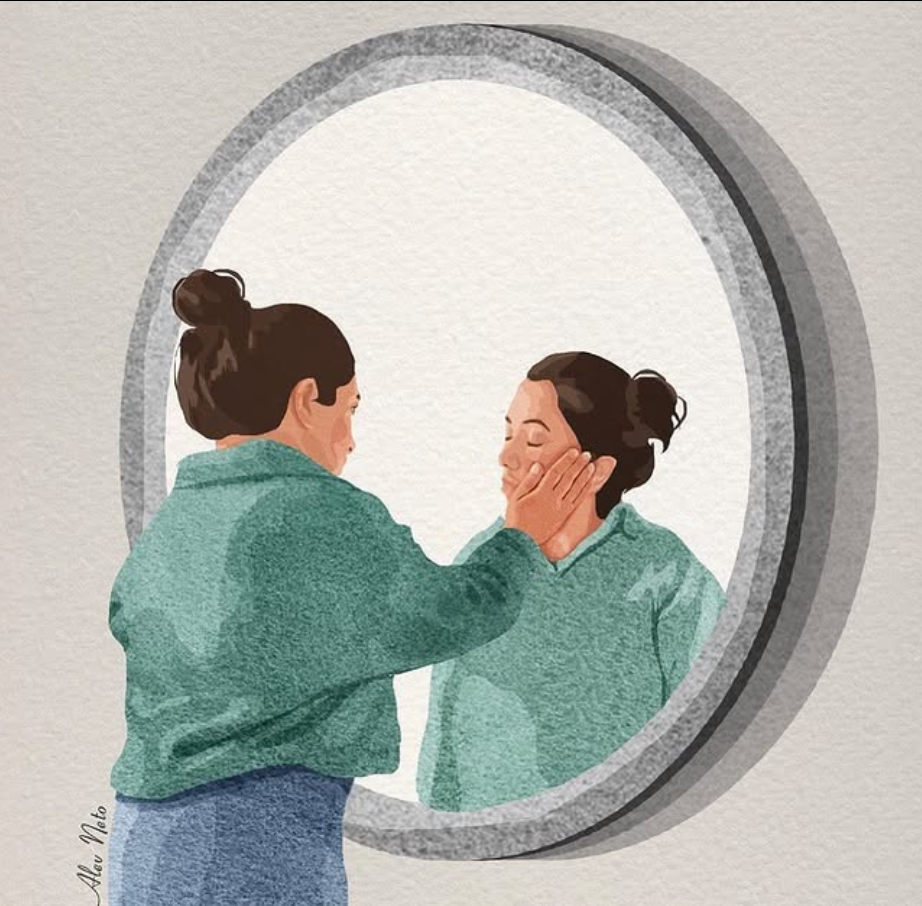
A photo of an artwork depicting a woman caressing her cheek in the mirror. | Photo from @alev.neto on Instagram
Jan 7. 2026 | Belen Ponce Leal | Lifestyle Editor
Special thanks to copy editor Kiera Roedel for being the inspiration to write this article.Ìý
I have a habit of saying “sorryâ€� a lot. Like, a lot. While apologizing is an important behavior that everyone has hopefully done throughout their lives when needed, I usually do it to the point where it isn’t. It isn’t something that I thought would be such a big problem. After all, I don’t want to be seen as someone who doesn’t take accountability for their actions.Ìý
Yet, I can recognize that a lot of the time, I don’t need to say sorry as much as I do. I am an overapologizer. Overapologizing is the act of apologizing so much that it becomes more of a defense mechanism rather than an actual apology. It is not something that a person will wake up with one day and begin doing. It is usually a learned behavior. It is something that has been developed throughout someone’s life without realizing it. Another term for overapologizing is “the anxious sorry.â€�Ìý
Definition —The anxious sorry is a type of safety behavior. A safety behavior, according to Psychology Today, is a type of “short-acting relief techniqueâ€� that people use to calm their fears or anxiety. They can involve both avoidance and escapism responses, such as procrastination, reassurance-seeking or even stonewalling. Safety behaviors aren’t necessarily a problem for those who do them, but they can become an issue when they have become the only coping mechanism that someone’s used their entire life. Healthy coping mechanisms like learning from mistakes, problem-solving and learning to accept things are all good ways of coping with issues or dramatic changes. Yet, when the automatic response someone has when facing an issue is “sorry,â€� it can be a clue into a much deeper problem developing in the mind of the apologizer.Ìý
What sorry means to an overapologizer —Overapologizers don’t usually say sorry all the time to be polite. It’s often because they fear something. Fear usually ties into all sorts of things, such as being scared of conflict, anxiety, low self-esteem and people-pleasing tendencies. The word “sorry” then becomes a replacement for feelings that a person may not have the capability of confronting or skills to cope with. Constantly apologizing can cause overapologizers a momentary feeling of relief from whatever bad feeling was giving them the need to apologize, whether it be fear of rejection or anxiety. It is that relaxing feeling that can make a person use the word as a strategy in maintaining relationships.Ìý
Potential problems — While saying sorry a lot may not seem like such a big deal, it can become harmful. It is incredibly diminishing to the apologizer’s self worth. It reinforces the thought that they’re wrong, that they are “too muchâ€� and that the person is responsible for the emotions of others. Apologizing a lot can also be confusing for those who are around you. Saying sorry often can make the word lose its sincerity, and then the person who you are apologizing to doesn’t understand what it is that is actually needed from the apologizer. There is an irrational fear of upsetting others or being uncomfortable when others around them are upset. Despite knowing that the problem didn’t come from them, overapologizers have this compulsive need to try to diffuse the situation before being able to feel comfortable again.Ìý
The signs — One overapologetic behavior would be apologizing for things that the person themselves didn’t do. Situations such as schedule conflicts, apologizing for someone else’s behavior, not carrying cash when it’s needed, etc. Oftentimes, it’s things that the person had no control over or prior knowledge of needing to do that they end up taking responsibility for. Another sign would be saying sorry instead of expressing a need. A good example of this that I personally have lived through would be saying sorry to a partner instead of telling them what it is that I want from them. There was a time that my spouse and their family wanted to go eat at a sushi restaurant. I was the only one who didn’t want to go, but I lied and said I wanted to because I didn’t want to be the reason they didn’t get the food they wanted. I tried to prevent a conflict between them and compromised my own wants to do so.Ìý
Likely Causes —Some causes for saying sorry frequently could involve the background of the overapologizer. If they were surrounded by people who were caring and understanding one minute and furious the next, they often have to learn early on how to anticipate the needs of others by minor things such as expressions, tone, hand movement and body language. That could explain the need to want to “diffuse the bomb,â€� despite not being the cause of it. Trauma is another major factor in apologizing often. A lot of people who experience traumatic events will often blame themselves for it in an attempt to feel in control of the situation. Yet, it can often make the trauma worse and make them perform people-pleasing behavior to feel safe. For people who think less of themselves or have low self-image, feelings of self-resentment can cause them to say sorry for things that often don’t need it. Having low self esteem can also make a person much more likely to be in codependent relationships. Being in a codependent relationship means that the person’s value is tied to their ability to keep the other person in the relationship happy. Taking the blame for whatever conflicts may arise between the two can often be a way to keep the peace to satisfy the other.Ìý
Like most problems that we as humans face, the first thing overapologizers need to do is be aware of the issue and try to combat it more. It’s important to become self-aware of how often they say sorry and what situations it tends to come up in more. Try to recognize the feelings that are being felt in that moment and replace the word “sorryâ€� with healthier language. Something I did when coming into work late due to a car issue was apologize for not being on time, despite the fact that I provided a warning and had no control of the situation. Something else I could have said was “thank you for waiting.â€� Small changes like this can make a big impact on breaking the cycle. Therapy can also be a very good way to combat the action and try to work through what it is that the word “sorryâ€� is replacing. It can be difficult to do, even uncomfortable.Ìý
However, I want to remind anyone who reads this that it’s okay to not be perfect. It’s okay to exist and take up space. No one is inconvenient.Ìý
A photo of the FedEx logo which shows the hidden arrow in the “Ex.� | Photo from @creatorspark on Instagram
Dec. 3 2025 | Belen Ponce Leal | Lifestyle Editor
One of the greatest shows of all time, in my opinion, is “Gravity Falls.â€� In the 17th episode of the first season, one of the characters gets brainwashed into staying with her boyfriend by a song. When one of the main characters, Dipper, plays the song backwards, a message is heard: “You are now under my control. Your mind is mine.â€� It is unknown where the character got the cursed tape, but that nevertheless opened my mind to the idea that some try to put hidden messages into various types of media.Ìý
Definition —The word subliminal, according to Oxford Languages, means “below the threshold of sensation or consciousness.â€� Subliminal messaging is the act of spreading messages or ideas that fall below the threshold of our conscious awareness. In small terms, it’s a method with which someone could communicate an idea in a barely noticeable way. Some think of it as brainwashing, a way to get people to do or crave something that they wouldn’t normally want. It’s most associated with advertisements as companies try to find a way to make their products more appealing in a subtle way.Ìý
History —The history of subliminal messaging can be traced back to the 1940s. They were occasionally inserted into radio, film and television. One example of this was back in 1943, in a Looney Tunes cartoon featuring Daffy Duck, the words “BUY BONDSâ€� flashed on screen. At the time, no one knew whether or not these messages would have an influence on the general public or not. They were just thrown into things to see what would happen.Ìý
Then, in 1957, a market researcher named James Vicary declared that flashing the words “Eat Popcornâ€� and “Drink Coca-Colaâ€� in movies for a fraction of a second would generate more sales of these snacks. After a few years, though, he admitted that he lied about the study. That incident led many to be concerned that people could use subliminal messaging in a manipulative way. The next few decades were then spent trying to figure out if subliminal messaging had any effect at all, with many claiming that the effects of it were completely fabricated. Yet, as more time passed, researchers concluded that there is an effect — it is simply much more subtle than previously believed.Ìý
The science —In order for a subliminal message to work its way into one’s brain, it is all about perception. Sometimes, a message can be very straightforward without even being noticed by the person witnessing it. Other times, the intention can only be seen after a second look. Subliminal perception is a field that focuses on the thorough examination of how individuals register information that is beneath the threshold of their conscious awareness. This is a difficult thing to study, as it’s hard to observe what people are unconsciously processing in their minds.Ìý
For instance, there are some who believe that the McDonald’s logo was carefully designed to be appealing to customers. Yellow is associated with happiness, while the color red is believed to make a person hungry. When thinking about other food chain coloring, it’s notable that many of them have those two colors somewhere in their logos. A much more extreme claim was that the arches of the logo appear like female breasts, which were intended to attract customers in a subtle, sexual way. While I’m unsure if I believe this claim, it is certain I will never look at the golden arches the same way ever again.Ìý
According to an article from the Association for Psychological Science, while subliminal influence on the behavior of people seems theoretically possible, it is only “among people who were already motivated to engage in a particular behavior.â€� During a study conducted by Johan Karremans, Wolfgang Stroebe and Jasper Claus, they found that they were able to influence what kind of drink the people in their study would attempt to get after they were shown various pictures of Lipton Ice. However, they found that the effects mostly worked on those who were already thirsty.Ìý
Modern uses —It is no surprise that the main source of subliminal messaging in the modern age is from advertisements. When subliminal messaging was first introduced in certain ads, it was mostly through flashing images for a split second. Yet, this is hardly used anymore, as most agree it doesn’t have very much of an effect on consumers. Fast food chains, grocery stores, factories and even sponsors use even smaller ways to get a message across to a large group of people. A popular example of a subliminal message would be a barely audible message heard in the background of an ad. It could be something as simple as “Buy nowâ€� or “This offer is only available for a limited time.â€� It drives a sense of urgency, which makes individuals more likely to impulse buy. There is also the way that a certain image is designed that can more lightly influence the way a person looks at it. For instance, the Wendy’s logo has what appears to be an “Mâ€� at the collar of her dress, which can look a bit like the word “mom.â€� This is supposed to make the customers think of home and comfort, the days when we used to rely on our mothers to make the home-cooked meals we loved growing up. It’s intended to play on our nostalgia. The FedEx logo is also another good example. If an individual were to look between the letters “Eâ€� and “X,â€� they would be able to notice the small arrow pointing to the right. It implies that they are quick and will get their packages out to their customers fast.Ìý
Honestly, it’s a little impressive how our brains are capable of picking up such minuscule things that we don’t process directly. While subliminal messaging can be ethically questionable, the effectiveness of the actual attempts at doing so seems limited. Still, it is important to really study the advertisement and see if it is really a needed purchase. Don’t let the fear of missing out be the reason to impulsively buy something that’s unnecessary.Ìý
Dr. Diane Hennacy has been one of a few scientists who have worked to test the theory that non-verbal individuals can use telepathy when communicating with those they’re closest to. Many professionals in the field believe her attempts are futile because she’s trying to prove a pseudoscience — science that isn’t based on the scientific method. In response to this, Hennacy claimed that many individuals around the world have proved telepathy to be true, but the number will never be enough to prove something that is labeled as impossible. Whether this theory is true or not is up for debate, but I’m going to dive into her research and findings.
Hennacy predicted that the group most likely to show signs of telepathy were non-vocal, autistic children with savant — exceptional abilities in memory, music, math or art — skills. She believed that these individuals were highly likely to feel more motivated in finding an alternative method of communication with their caregivers, starting at a very early age. She even argues that telepathy isn’t that much harder to believe than savants themselves, because savants know a multitude of information without any history or exposure to it, something that can also feel impossible. The examples she provides for this include twins who could provide prime numbers up to 20 digits without knowing basic math, and children spontaneously drawing the periodic table without previously being exposed to it.
Families who heard of her work reached out to her because they felt their children were exhibiting signs of telepathy. Hennacy tested three children in the United States from families that reached out, and found results that she felt pointed towards telepathy. She tested each child with randomized words, letters, numbers and pictures, and each child was able to identify them with astoundingly accurate results. While her conclusion is that telepathy, or something similar, must be going on, she acknowledged that her testing protocol was not optimal.
Hennacy’s working theory for how telepathy works has to do with how autistic brains function. When these groups of people engage in cognitive tasks, their cortex is relatively quiet, while that of a neurotypical individual is very loud. Because of this, those with autism are often extremely detail-oriented and able to perceive very subtle changes that a neurotypical person may not catch. Hennacy predicts that if telepathy has anything to do with separating signals from background noise, these individuals’ high sensitivity would make them more likely to experience this. Additionally, savants have high accuracy in sensory perception, and those with autism are often not limited by beliefs about what is possible, while neurotypicals only see what they expect to see.Ìý
Another aspect that makes proving her theory difficult is the fact that a lot of these individuals use facilitated communication. This means that, while the child would type out an answer, their parent or someone close to them would be supporting their movements through physical touch. Many skeptics of Hennacy’s theory speculate that these children just have their parents putting in the correct answer, or nudging them in the right direction, since they’re being supported with touch.
One of the individuals Dr. Hennacy tested was a 9-year-old mute and autistic girl named Haley. She does not use facilitated communication, and instead she communicates by pointing to letters and numbers, or by typing into a device called a talker that provides text-to-speech. Initially, Haley’s parents thought she was a math savant because she could solve complicated equations with no prior knowledge. At one point, her therapist gave her an exponential equation, and she typed the answer into her device unprompted. Her therapist had accidentally switched the calculator only the therapist could view to display the answer. Shocked, the therapist asked how Haley knew the answer, and Haley typed, “I see the numerators and denominators in your head.� To follow this, Haley would type in answers to things only her therapist knew, such as her landlord’s name, the exact words her therapist was thinking when looking at a picture that wasn’t visible to her and even novels that her therapist knew word for word, some even in foreign languages.
Bo, an 11-year-old boy, showed similar traits to Haley. His mother said he would often tell her words or numbers that she hadn’t outwardly expressed. Like Haley, Bo could tell the answer to any math equation he was given as long as his mother knew the answer or was looking at the answer. If his mom didn’t know the answer, he could no longer solve the equation. Bo’s ability to correctly say a word or number his mom was thinking of was tested. He received a blindfold and went to the opposite side of the room, facing away from his mother. With these restraints, Bo was tested on 25 different answers 14 times, and ended with an average of 84% correct.
Ramses, a 5-year-old boy with autism, could read seven languages out loud by 2 years old and could solve algebra problems from age 4, both signs of a savant. His mother reported him to Dr. Hennacy as being telepathic with her. Hennacy used a random number generator to test Ramses by generating a number, giving it to his mother in secret, and asking him what the number was. His overall accuracy was 90%.
The scientific method is tried and true, so it can be hard to be open to such a far-out topic that isn’t supported by it yet. Who’s to say, though, that we won’t have the information someday to fully support the idea of telepathy in nonverbal individuals. I believe that furthering scientific advancement involves looking at things that feel impossible, and what feels more impossible than the idea of telepathy?
In February of 1998, a research paper was released linking autism to vaccinations. This paper has long been proven to be false, with multiple factors in the experiment being questionable at best. Unethical decisions and “callous disregardâ€� for the children that participated in the study are just a few reasons why people questioned these findings. Then, 12 years after the paper was released, one of the doctors who worked on this study admitted that several elements of the paper were incorrect. Despite this, there are still a small number of people who wholeheartedly believe these vaccines are harmful.Ìý
The definition of a fact, according to Oxford Languages, is “a thing that is known or proved to be true.� Yet, we live in a world where it is getting harder to distinguish what is true and what is partially true. Even with the accessibility of information at our fingertips, there are many who will believe a video they watched on social media to be fact, despite the very real possibility that it may not be true. Or it may have been misconstrued — it may be factually correct, but lacking context. However, after researching this subject, I’ve come to the realization that facts by themselves don’t usually convince people to change the way they think. It’s often tied to emotion and community.
We as humans are a species that needs a semi-accurate understanding of the world in order to live in it comfortably. We are also very social creatures. Since the dawn of the species, humans have traveled in tribes, working together to survive. Accuracy and truth aren’t the only things that are important to the human mind. We also have a desire to belong. Humans have always had the desire to bond and have relationships with others. We want to be people who fit in and have the approval of others. It is difficult to think of a feeling worse than rejection or disapproval by the person you want it from the most.
In a lot of people’s minds, social connection is more helpful to us in our daily lives than it is for us to understand the truth of a certain idea or fact. We sometimes compromise the truth to make ourselves look better to certain people or a certain community. False beliefs might not be useful in a factual sense, but they are in a social one. James Clear, who wrote an article called “Why Facts Don’t Change Our Minds,â€� calls this way of thinking “factually false, but socially accurate.â€� When it comes to choosing being right over friends and family, the latter usually wins. This is why we, as people, tolerate things that might offend us. It is why a person will bite their lip and turn away if a family member says something that offends them.Ìý
Another thing to consider is motivated reasoning. This is when people go to great lengths to try and persuade others that the facts are incorrect or that sources are unreliable. Humans are hard-wired to have an emotional response faster than our conscious thought. Information that supports a person’s preexisting view on the world or thoughts on a subject will be accepted a lot faster than something that completely contradicts it. A lot of the time, people do this to make themselves feel better about new information that contradicts their beliefs.Ìý
That also ties into the misinterpretation of facts. A lot of facts are taken completely out of context to be used to support an argument that the fact wasn’t intended to be used for. Some usually do this, not necessarily to tell the truth, but to “proveâ€� their point of view or attack another.Ìý
So, if facts can’t change a person’s worldview, there has to be another way to do it. After all, we are all constantly evolving and changing our beliefs. The best way to change someone’s mind is by giving them a new view of what a community looks like. If someone were to completely abandon their beliefs, they would lose their family and their ties to the community that embraced them. James Clear put it best: “No one wants their worldview torn apart if loneliness is the outcome.�
However, like the vaccine belief, these ideas can hang around for a while. A reason that they do is because people continue to discuss them. Ideas are remembered when repeated — that’s also the only way they can be believed. A person is more likely to believe a crazy concept if it comes from someone they know. The train of thought is usually something along the lines of “I know this person. I like them, I share some beliefs with them, why should I not consider this one too?â€�Ìý
One way to combat this is to let the ideas rest; let them die out and be forgotten. This isn’t to say not to speak up for people who are attacked. However, maybe we as people need to change our strategy in dealing with these situations. Being ignorant is a lot harder to do when the person has friends who think differently than they do. Befriending them and being kind to them is the best way to give someone the opportunity to change their beliefs. As Selena Gomez said, “kill ‘em with kindness.�