ֲƵ

Mount Hood

Income inequality and the American family

By: Brian D. Tesch
Advertising Manager

Lately, income inequality has become a very hot topic. With all the coverage from the presidential campaign, it seems like everyone has an opinion on it. What’s not being discussed, and what is perhaps even more troubling, are the correlations between income inequality and the American family.

The Pew Research Center has placed some rather surprising numbers on the status of American families. Divorce rates by the number of marriages have doubled over the past 50 years. Household sizes have dropped by 25 percent, and the number of births to unmarried women has risen a whopping seven-fold.

Children that grow up in a household where one parent is absent for a period of time, whether divorced or single by birth, are at a great disadvantage to other children when it comes to social mobility. They are actually half as likely to move up, compared to kids raised in a household with two parents. Social mobility is the leading factor to income inequality, and it’s important we understand why this is.

It is actually quite simple; two parents are better than one. Double the experiences, double the knowledge, double the capital, and double the support. For economists like Professor Zenon Zygmont, they prefer to call it “double the human capital.” Zygmont explained that human capital is the most important element to any economy and also to any individual.

“Look at countries like Japan, and Germany between 1940’s and 1960’s.” Said Zygmont. “After the war, most of their physical capital was completely destroyed. But in 20 years they were able to completely rebuild their countries.”

While physical capital seems more tangible and more important to us, the importance of human capital must be emphasized. For the most part, a majority of an individual’s human capital is developed before they turn 18.

Primarily, parents play the biggest role in the development of human capital. In single-parent households, there is less human capital available to children. Maybe that’s why children living in a single-parent household in the United States are twice as likely to drop out of high-school, twice as likely to have a child before the age of twenty, and one in a half times as likely to be “idle” (being out of school and out for work).

“But that’s not the full story,” said Professor Mike Mcglade. 55 percent of births in Sweden are actually from unmarried women.

“Despite this, social mobility remains high, and child poverty rates are next to nonexistent,” said McGlade. It’s no mystery why; it’s all about public policy.

McGlade pointed out that Swedish parents are entitled to up to 480 days of paid maternity leave; while maternity leave in the United States is non-existent.

Maternity leave, and other policies that support single parents, allows single mothers to spend the time with their child. It helps them compensate the lack of human capital a single parent can offer. It is why children that grow up in single-parent households in Sweden are at less of a disadvantage, in terms of lifetime social mobility, as children in the United States who grow up in single-parent households.

Contact the author at btesch14@wou.edu

A year of silence

By: Samantha Lindsey
Guest Contributor

My labels include: 21-year-old, white, woman, pro-cannabis, pro-marriage equality, pro-choice, pro-universal healthcare, pro-LGBTQ rights, pro-border security, registered Independent, who voted for Donald Trump. I urge you to read on.

About two months ago, I was doing my homework in the Academic Learning Center, as I do most mornings. Across the room, however, the cubicles made noise. Employees chattered, sipping their hot, morning beverages. What I heard were the familiar sounds of scoffing and wonder: reminiscing shards of rhetoric regurgitated from the second of three presidential debates. Condescending banter, the kind that had made me silent for more than a year now.

In my time at university, I’d learned to keep my tongue pressed between my top and bottom jaw. These days, at a place that claims to accept all minds and opinions, those against the hive lose civil rights, and human dignity.

University made a promise to me, a promise that when you are in this environment, you will have your views challenged on fair and just grounds. Yet, in the last year, what should have been a healthy political debate, generated a persecution. I was labelled: bigot, sexist, racist, xenophobic, transphobic, victim-blaming, slut-shaming, woman. In the course of a year, I was called all of those names, and more, that can be generally embodied in the label: ignorant. Needless to say, I spent a year living in a country divided, in a community of like-minded peers where outliers were overwhelmingly unwelcome.

It was a year spent where I could not speak on a topic I care so deeply about and followed so closely. I could not speak freely, and when I did, my views on platforms such as the economy were dismissed and I was labelled. A long year was spent watching my white, 17-year-old brother, and my white, 23-year-old boyfriend be stereotyped as rapists and sexists because of their color and gender.

It was a year where professors would subtly mention Hillary Clinton in their lectures, as if everyone shared the same view, as if this election was a no-brainer. It wasn’t. A year where, if you weren’t solidified in your vote by the time the primaries were over, you were ignorant. It was the year I was too afraid to even speak to anyone in my community without being labelled a sexist, racist, xenophobic, transphobic, etc.

I was relieved on Nov. 8, 2016, at 11:43pm. Not because the candidate I voted for won. No, I was elated to finally re-stitch the part of my tongue that had been severed by my community, in order to prevent pronunciation of my political views.

I listened, for a year, and what I got out of it is that this society is much more biased than I knew before: from hot-headed-headlines condemning Mr. Trump, to being called a bigot by my peers, and being silenced. I wanted to be heard, yet nobody would sit down and listen.

When The New York Times admitted the need to embrace the mission of journalism again, it became clear this election was nationally ruthless. We were left in this burning dump-yard of a nation: where we no longer listen to one another’s views peacefully, rather, we persecute and stereotype. All I can hope is that we learn something: because four years from now, we vote again.

Contact the author at slindsey16@mail.wou.edu

Campus Voices

By: Ashton Newton
Entertainment Editor

Question: Do you think celebrity activism is positive or negative for society and why?

Kailee King, sophomore, pre-nursing
“I think it’s a positive thing because they bring the attention they get and use it for good”

Brent Sumner, sophomore, criminal justice
“I think it can take both effects. I’d say probably more positive if it has a positive message, because some people really look up to celebrities, maybe more than they should. They can be a big source of power to talk to more people than a politician might have.”

Joel Haro, sophomore, education
“I think it’s a positive thing because they have such a big influence, especially on young kids. If they’re able to use their platform for something good, I think it’s useful.”

Sergio Lopez, sophomore, criminal justice
“I think it’s positive for society and for everybody just because they’re humans too, not just celebrities. They have their own private lives, so they have the voice and the option to say whatever they want.”

Ashlynn Walker, junior, ASL studies
“I think that is it a positive thing because they do have such a big platform and they are able to influence a lot of people, but I do think that’s the negative part as well because some people aren’t able to think for themselves and create their own ideas from what they know. A lot of people take what celebrities say as fact, and they get paid for that, so for the most part I’d say negative.”

Opinion: Violence is not a one party problem

Placing blame on one movement isn’t going to heal the divide we currently have in our country

Sydney Carpenter | News Editor

The Western Howl’s writing season and my time here as the News Editor are coming to an end. Over these last couple weeks, I’ve been reflecting on my first year of journalism ⏤ most notable, but not to disregard any of the other stories I’ve written, are the articles covering various gatherings and events at the Capitol. A joke in the office is that if you can’t find me, check the Capitol building.

I’ve attended rallies, protests and riots just like a lot of other Western students. Regardless of which side of the aisle organized the events, I can say I personally have been maced, mobbed and assaulted by the left and the right side.

As a student journalist, I’ve been asked to leave because “fake news media isn’t welcome,” “liberal fake news media isn’t welcome,” “we don’t want people taking pictures” or because “you’re suspect.” At times I’ve had my own life threatened or the safety buddy I bring with me has been threatened.

Regardless of these experiences, I’ve been able to talk to people, and I think the most mind boggling thing for me is when I’m asked about the various articles I’ve written tackling these events. The interviewee I speak with is always shocked when they hear I’ve been verbally and physically assaulted by the side they stand with.

People who identify as standing on the left are often quick to point out the violence of the right, but there are instances where I was in the midst of a group of antifascists who set off a can of bear mace as other members of the movement paintballed a car with stickers corresponding to right wing ideologies. When I’ve gone to rallies designated as right wing events, I’ve been escorted out by people identifying as “Proud Boys.” At these rallies, they spend a lot of time judging and criticizing the left group, associating them with rioters and looters. However, there is no mention of instances where right wing groups have personally assaulted journalists or made threats on people’s lives.

I think another important point to make is that sweeping generalizations aren’t being made; at these events, there’s never just one or two sides that are present. You have a giant gumbo pot of beliefs that don’t always agree with each other. I’ve seen radical movements violently attack vehicles and people, while other protesters cry and beg for them to stop hurting people and causing damage. Sometimes there were mock “militias” that acted as security and were under orders of one person; if you fall on their radar, they will have that group swarm you and what they choose to do to you depends on who you are. Often, when I’ve had this happen to me I’ve tried to stand up for myself and verbally disarm them. There’s always one that is willing to listen in an unaggressive manner.

Since Jan. 6, the tension in Salem has been particularly palpable. Every weekend, there are different movements staking claims to particular areas of downtown. The police presence is noticeably dismal — until you have a group of people standing outside of the Capitol building. While you have cases of violence within various areas, the police have in some cases permitted harassment and assault to be the standard at some of these events. I have literally run into an undercover cop posing as a gardener in a construction site, and after telling him that a group identifying as “Proud Boys” swarmed and assaulted me and my friend during a Second Amendment Rally during May Day, he said thank you and walked away.

The Salem police have made statements saying they don’t want to make the situation worse by adding a visible presence, so they send undercover agents; but, even after I reported what happened to us, we were left to our own devices. I later reported the harassment to police officers that showed up after the event was over and all they said was that they would make a report.

The point is, there are cases of violence all over and we can’t continue to use divisive language to argue which event was better or worse than the other. We can’t continue to have fierce party loyalties, as it’s only generated this atmosphere that creates enemies. Some veteran journalists who have actually gone to war zones have told me that what’s going on in our country is reminiscent of the experiences they’ve had. The most interesting part is that people are taking sides, but their beliefs don’t always align; it’s strictly party loyalty or party resentment.

The gap we have keeps growing wider and wider as time goes on. As blame is placed and fingers are pointed, we seem to choose to tune out each other’s voices. “If you’re not with us you’re against us” seems to be a running theme. But anger and hatred don’t have to be matched. We can lower the temperature and meet as equals, but I think in order to do that we can’t continuously point out others’ faults.

There has to be self acknowledgement that the political atmosphere has spiralled out of control and trying to throw water on an oil fire isn’t the solution. Explosive discussions are going to be our downfall if our views of the “other side” don’t change. I think we can all agree, where we are right now is not where any of us want to be.

Contact the author at scarpenter18@mail.wou.edu

The Northwest Passage

Written by: Hannah Field | Editor-in-Chief

“The Northwest Passage” is Western’s student-run literary and art magazine right on campus, composed of submitted works from students, faculty and alumni of the school. Each magazine showcases various different creations, such as traditional art, digital art, photography, poetry, short stories, lyrics and other art forms.

Founded in 1941, “The Northwest Passage” has been supporting student artists ever since. The first issue of the 2024–25 school year, being the Fall issue, is expected to be released Dec. 4, prior to winter break.

Recently appointed to the position, Editor-in-Chief Anna Gillock has been working diligently to promote and create “The Northwest Passage” for the 2024–2025 school year. “(One of my priorities) not only as the (Editor-in-Chief) but as a student and an artist is to support the creativity of my peers in the most accessible way possible,” said Gillock. “This is all very new to me, but I feel confident in the support I am given by the staff here at (Western) and I hope that I can give myself enough breathing room to really put myself into this publication for the short time I am in charge of it.”

On top of that, Gillock has been prioritizing accessibility and understanding this year with “The Northwest Passage.” “For instance, I have ADHD, and knowing that many of my peers are the same way, I use my knowledge of graphic design to visually emphasize the most important bits of content in a way that I feel is easy to process,” said Gillock. “With so much information being thrown at us as students, I want to try and provide content that is not overwhelming to look at. It’s a specific example, but that is just my personal mission as (Editor-in-Chief).”

Submissions may be emailed to northwestpassage@wou.edu and no more than five pieces per person are published in a singular issue. It is asked that personal names are left off of the submissions so that the editorial board, which votes on which pieces appear in the magazine, remains unbiased. Pieces can be submitted with a title; if a title is not provided, they are regarded as “Untitled.” All written work must be less than 1,500 words and must be submitted either as a PDF or a document. The Editor-in-Chief reserves the right to alter submissions but will not publish any edited work without the creator’s permission.

Gillock placed a lot of importance in the art specifically as to why she claimed the position at “The Northwest Passage.” “I have been writing and creating art since I was first able to hold a pencil,” explained Gillock. “Even before I was hired on to be the EIC, supporting my fellow artists has always been a passion of mine, and I am really grateful for this opportunity to do so.”

Contact the author at howleditorinchief@mail.wou.edu

Campus Voices: sharing their feelings on the mask mandate lifting

Western students answer the question: “What is your raw, honest, unfiltered, opinion about the recent lifting of the mask mandate?

Gretchen Sims | Freelancer

Contact the author at gsims20@mail.wou.edu

Name: Ruth Simonsen

Class standing: sophomore

Major: psychology

Pronouns: She/her

“I like seeing people’s faces. I like knowing when I smile at them that they will smile back. I like seeing the faces of people in my clases. Of course there are still fears, but I like being able to put a face to a name and a name to a face. I feel like when you can see people’s faces and can smile at them, it is easier to be friendly. It’s just a better vibe.”


Name: Makaela Calonder

Class standing: first-year

Major: pre-education

Pronouns: She/her

“Personally, I am very excited about not having to wear masks. I work at a pool, so in general — in my daily life ⏤ it is nice because it gets very hot and sweaty in the mask. Here at WOU it is nice not having to worry about not having one on me at all times. Of course I respect everyone who still chooses to wear a mask, but for me it is really nice.”


Name: Kamryn Bolan

Class standing: first-year

Major: business

Pronouns: She/her

“So far this year, especially as a freshman, I have felt very distant from the community of students here. Over the past two years, it’s like we have forgotten how to socialize. I think there is so much personality revealed in a person’s face, so when you cover half of it up, you have trouble connecting with the person you just met. Going into spring term with masks off has given me a new sort of motivation for going to class. It’s crazy how much seeing the teacher’s face can amplify your engagement.”


Name: Sienna Painter

Class standing: junior

Major: American Sign Language studies

Pronouns: She/they

“Throughout the pandemic, I have been very cautious through shutdowns. (I) was not going anywhere other than like the forest during the shutdown. I started wearing a mask in January of 2020 — long before everything. I already had masks because I have been wearing masks since like 2018 whenever I felt sick or whatever, so I was already really comfortable with masks to begin with. For mask mandates being lifted, right now, I am very skeptical–mainly because of Spring Break. We lifted the mask mandate in all of Oregon, California and Washington right before Spring Break — right where all of WOU students would be traveling too. That’s why I am still wearing a mask to all of my classes and will be especially more cautious over the next two weeks. Also, I am like f—–g scared of COVID because of all of the variants and waves and stuff. I have never really minded with masks, but I do think because of our (WOU’s) high vaccination rates, and WOU is a pretty small campus, and people are fairly responsible, I am fairly comfortable with other people not wearing their masks. I also have not felt pressure to take my mask off. I was afraid I would be the only person in my classes not wearing a mask, but people have been pretty chill.”


Name: Max Brayton

Class standing: first-year

Major: psychology

Pronouns: They/Them

“My parents are more conservative and Republican so they have been against the masks since the beginning and it’s nice to not hear s–t from them anymore. But, you know, with them as my parents, I see different perspectives which is interesting. Although I don’t agree with them, it is nice to have that perspective. I am from southern California and even down there, they are not being as safe as we are (in Oregon). I feel more comfortable not having my mask on here because I know, at least at our school, that more than ninety percent of people are vaccinated. Everyone has been really safe and respectful. Like I feel comfortable wearing, or not wearing, my mask here. I feel like this community has been very welcoming and inclusive and I feel like it’s about time (the mask mandate was lifted). I am a little nervous though. I saw a New York Times article this morning that a new COVID wave is hitting, but I feel like as long as everyone is being safe, I like to have my mask off ⏤ you really connect to people more.”

Favorite season for a reason

Western students answer the question: “What is your favorite season and why?”

James Fowlkes | Freelancer

Contact the author at jfowlkes18@wou.edu


Name: Will Ollenbrook

Age: 23

Class Standing: ܲԾǰ

Pronouns: /ᾱ

Major: Computer Science

Favorite Season: Բ

𲹲Dz():

“I think it’s probably due to, just like a lot of personal reasons. I’m Irish so, included in Spring usually comes like Saint Patrick’s Day and things like that. Also, I had my birthday recently. That’s another thing that happens around Spring. It’s relatively chilly but not like super cold weather around Spring. It’s a bit more rainy around here in the Pacific Northwest but I don’t really tend to have an issue with that.”

Name: Xavier Glenn

Age: 20

Class Standing: DZdzǰ

Pronouns: /ᾱ

Major: Physical Education

Favorite Season: ¾Գٱ

𲹲Dz():

“Probably winter just because I like to go out and play in the snow and stuff, and it’s probably the best season for dressing, like layers and things like that. Also, I just like the holidays too, so like Christmas time. I guess Thanksgiving kind of counts in winter too, maybe like fall, but holiday family time as well. I think winter is also good because there’s just a stronger, like, sense of community I think and people are trying to get through the hard winter as a family or things like that.”


Name: Cedar Davis-Frankfort

Age: 21

Class Standing: ܲԾǰ

Pronouns: /ᾱ

Major: Elementary Education

Favorite Season: ܳ


Reason(s):

“I just enjoy the warm weather and I’m a distance runner so I like running during the summer ‘cause it’s warm out and I don’t worry much about school so I can just run whenever. I enjoy traveling and there’s more time to travel and explore new places.”

Name: Brittany Waligroski

Age: 21

Class Standing: ܲԾǰ

Pronouns: /

Major: ASL Interpreting

Favorite Season: 󲹱


Reason(s):

“I really like when the leaves on all the trees change colors. It’s just super pretty and then it also has my favorite kind of days that are (sunny) but cold.”


Name: James Ceciliani

Age: 22

Class Standing: Ծǰ

Pronouns: /ᾱ

Major: Criminal Justice

Favorite Season: Spring


Reason(s):

“It’s always good to look forward to summer. Sun starts to come out again and we can start going outside a lot more. It’s not super hot and I’m not a big fan of blistering heat but I usually go out and go on hikes and such. (It’s) just sunny, and the days get longer, that’s a big one. And seasonal depression starts going away. I’m an umpire, so baseball starts up again and it’s just gonna be outside.”


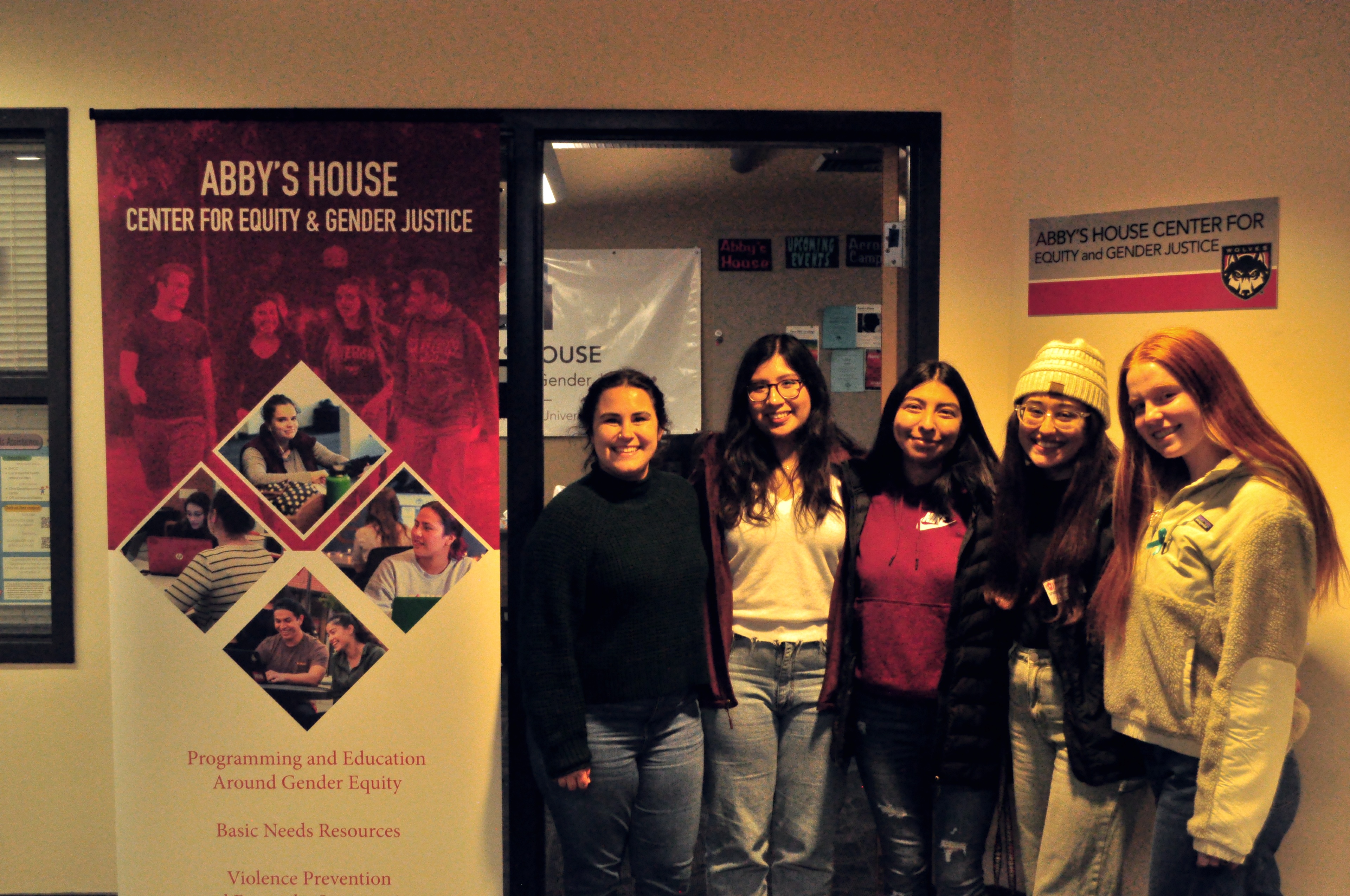
Abby’s House discussing plans for future Wolves Against Interpersonal Violence committees

Abby’s House discussing plans for future Wolves Against Interpersonal Violence committees


Gretchen Sims | Freelancer

Contact the author at gsims20@mail.wou.edu

Content warning: this article mentions sexual assault.

According to the Rape, Abuse & Incest National Network, 13% of all college students experience rape or sexual assault by means of physical force, violence or incapacitation — 23% of undergraduate female identifying persons and 6.8% of undergraduate male identifying persons.

These statistics are understandably alarming. Fortunately, Abby’s House is extremely aware of the critical need to push back against interpersonal violence.

The idea for the Wolves Against Interpersonal Violence committee began as a grant requirement during the 2010 school year. Although funding was renewed several times, it eventually dissolved in 2019. After that brief pause, Western staff expressed interest in continuing the program, which was previously known as the Campus Against Sexual Assault committee.

Although a finite list of objectives for WAIV has not yet been cultivated, Kristen Perry, Director of Abby’s House, envisions several for WAIV’s future.

“Personally, I’ve worked (in programs similar to this) at a few different campuses. I’ve seen things that work, and I’ve seen things that don’t work. My dream is to have everyone — across campus — on the same page on what prevention and education we offer, what training we offer, what our victim services are, how we can respond and what the conduct case management process is,” Perry stated. “But I can’t do that alone, I’m glad that the WAIV committee is here to help move along those types of goals — those dreams.”

Right now, many individuals are working together to make Perry’s visions come true. The WAIV committee currently includes individuals who specialize in conduct and Title IX, individuals from Residential Education, Student Health and Counseling, Public Safety, Abby’s House and select leadership members.

At current meetings, the committee discusses what is currently being done across campus to prevent interpersonal violence and what could be done to improve the experiences of survivors.

In the revised and finalized version of WAIV, the experts and committed people that compose WAIV will be split into three subcommittees.

The first will deal with prevention and education which will focus on consent education that is required for students. This committee will also focus on bystander intervention and other education that is offered across campus.

The second subcommittee will focus on policy. It will revise policies, ensure compliance and also educate the campus on some policies that they need to be aware of — such as Title IX and the Clery Act.

The final subcommittee will be a response committee — training faculty and staff on what to do if a student discloses to them. This subcommittee will also focus on the confidential advocacy offered in Abby’s House, qualified Sexual Assault Nurse Examiner exams offered at SHCC and how Title IX investigations are performed.

Sometime in the near future, Abby’s House will be searching for passionate students to sit on committees and help assist with the response to SA on campus. If interested, keep an eye out for more information or reach out to Kristen Perry or Abby’s House directly.


Abby’s House has two confidential advocates who can meet with students who have been affected by interpersonal violence such as sexual assault, dating violence, harassment or stalking. They can offer emotional support, reporting options, medical assistance, financial support, academic assistance, support around building coping skills and referrals to other resources both on and off campus.

The value of esports

Written by: Nicholas Sarysz

As technology continues to advance, so does the world of gaming. Esports, or electronic sports, have taken the world by storm and it has become a billion-dollar industry. The rise of esports has sparked the debate of whether it is actually a sport.

Professional players and teams compete against one another in a variety of video games as part of esports. These contests can be held live or online and they can range in size from small regional competitions to major worldwide events like the League of Legends World Championship.

Over the past ten years, esports has experienced exponential growth, attracting millions of viewers to watch their favorite teams and players compete.

Esports proponents cite that, like traditional sports, it incorporates competition and calls for skill and strategy as evidence that it qualifies as a sport. Esports athletes need to have exceptional hand-eye coordination and be able to react and adapt quickly under pressure.

Like conventional sports, esports demands a lot of repetition and training. Professional esports players frequently spend hours each day developing their abilities.

We are likely going to see gaming evolve even further into the sports world, as it may even become an Olympic sport in the future since the International Olympic Committee has already recognized esports as a legitimate competitive activity.
Frankly, I feel that a “competitive activity” is all it should be labeled as. Just because there are people engaging in competition, does not make something a sport. Furthermore, spending time honing a craft does not make something a sport, as that can be done with any hobby — not to mention that’s also how jobs work.

Esports also lacks any true physical component to be labeled as a true sport. While esports players certainly require mental and physical dexterity, their activities don’t require the same level of physical exertion as traditional sports.

There is no denying how incredibly powerful the esports industry has become — given it is now over a billion dollar industry — but to say that these competitive gamers are athletes is comical and blatantly disrespectful to the passion and work ethic that traditional athletes have.

Contact the author at howlstaffwriter@wou.edu

Can small schools make as big of an impact?

Written by: Nicholas Sarysz

As someone who is soon to be a college graduate, who has attended four different universities throughout my four years of college, I can confidently say that there is no one-size-fits-all answer to the often-asked question of whether small colleges are as good as large colleges. Ultimately, the decision of where to attend college comes down to individual preferences.

On the one hand, small colleges can offer a more personalized education. With smaller class sizes and a more intimate campus environment, students at small colleges have more opportunities to build relationships with their professors and peers, which is something a lot of people look for when choosing a school.

However, small colleges often have limited resources, both in terms of academic programs and extracurricular activities. This can impact students’ opportunities to explore different areas of interest or gain experience in their chosen fields. Additionally, small colleges may have limited name recognition outside of the general area where they are located, which may impact students’ job prospects and graduate school opportunities.

The biggest issue with small colleges is the “big fish in a small pond” conundrum, where a lot of students may gain a false sense of superiority given their lack of socialization with and understanding of the real world. This often creates a less welcoming environment for students who don’t fit into established social circles. Usually, there is far less cultural diversity within a smaller university campus as well.

Larger colleges, on the other hand, offer a much wider range of academic programs, research opportunities and extracurricular activities. There are often more options for clubs and organizations, as well as more diverse perspectives and experiences to learn from and immerse yourself in. Larger colleges also have more name recognition and resources to support students’ career and graduate school aspirations, thus providing more flexibility for those who want to relocate after they graduate.

In my personal experience, I much prefer larger universities. Larger college campuses are like their own town with daily events, multiple restaurants and things to do, making them a lot more fun. On top of this, extra fees such as incidental and meal plan costs tended to be noticeably cheaper at the larger universities I attended. Just know that private colleges are hardly ever worth it — unless one obtains an abnormally large scholarship.

All in all, a degree is just a degree, no matter where you get it from. It is not much other than a symbol of wasted money, a ticket to higher education or a one-way entrance into the bottom of the corporate ladder.

Contact the author at howlstaffwriter@wou.edu

Is college the best four years of your life?

Written by: Mirella Barrera-Betancourt

I’m a hardcore pessimist, whether I intend to be or not. I have a tendency to see the worst in people before I ever begin to trust them, and I cringe at overly excessive exuberance and optimism. 

However, the pessimist side of me once became excited at the prospect of university. I thought that the “college experience” — my college experience, to be precise — would be different from my high school experience. 

I thought “This is my chance to live life to the fullest,” only for me to begin attending college well into the peak of the pandemic, with the musky scent of a dorm room in the sweltering heat of summer, no friends or acquaintances in town — besides my residential assistant, of course — to get ice cream downtown with and only the feeling of homesickness swirling around in my gut, essentially destroying my motivation and drive for the years to come.

Now, as I approach my fourth and final year of college, I have found myself in a pickle when it comes to feelings of joy and regret. While I am overjoyed at the thought of nearly being finished with my degree, I cannot help but question myself over whether I could have done more to make my college experience the best it could have been.

There are times when I will bolt upright on my bed and ponder if this is it — the college experience that is so glamorized and portrayed as a spiritual and mind-blowing adventure.

If the weekly assignments, research essays and exams — mixed in with my social anxiety and chronic pains frankly ill-suited for a person my age — were not enough to leave me stressed, I am constantly worrying about how I will afford to pay my remaining college expenses out of pocket. I do not remember that being a part of the college experience.

Moreover, I never had a reference to turn to in regards to the college experience, as the first person in my family to attend college. However, I wish that someone — anyone — had disclosed to me back as a senior in high school that the university experience is not at all sunshine and rainbows as it is portrayed out to be on social and mainstream media. 

In my case, it is definitely not where you meet your lifelong friends, make your wildest memories and/or meet the love of your life. I have a hard time attempting to convince myself, but I am here to tell you that it is okay to not see your three or four years in college as the perfect, best years of your life. 

I have the remainder of my 20s and 30s to live life to the fullest, as well as my 40s — and hopefully 50s.

Contact the author at howlnews@wou.edu

All for one, one for all

Written by: Dakota Gange

Finding what is conducive to one’s success as a student can be challenging. Western has a plethora of resources available for students, many of which are located in the Werner University Center — a central campus location that is full of student aid.

From Abby’s House assisting students with basic needs, to the Center for Professional Pathways helping students to navigate possible careers and internships, to the Non-Traditional Student Lounge, there’s help where Wolves need it.

Next to Caffé Allegro lies the Freedom Center — a room that is nearly impossible to miss upon entering the WUC. Their atmosphere is bright and welcoming, offering a casual lounge and living room setting with T.V., music, snacks and drinks; a study table, test-taking resources and most imperative, immediate drop-in student-led advisory that can be an aid for everyone in answering questions one may have. This includes basic questions about how to navigate DegreeTracks, all the way up to helping students with their DACA — Deferred Action for Childhood Arrivals — paperwork.

The Freedom Center was founded by minorities and established as a safe place for BIPOC students to gather; all ethnicities are welcome.

If one were to walk into the Freedom Center today, they’d find a recently rearranged, calming and welcoming atmosphere — while visiting I felt comfortable, welcomed and confident.

However, recently circulating among various campus departments, including ASWOU, is a letter suggesting the closure of the Freedom Center.

In a Western Howl “Letter to the Editor,” a person the Howl will not be naming, wrote:

The majority of faculty and students at WOU are white females. This is not surprising as it is a teachers’ college in Oregon and females are historically the majority in education and Oregon is overwhelmingly white.

Society would benefit in many ways if more males from ethnic minorities became teachers (Black males are particularly underrepresented in the teaching profession) and WOU should lead in recruitment.

Unfortunately WOU’s creation of a ‘Freedom Center’ as ‘a safe space for BIPOC students’ and ‘to provide a refuge for People of Color’ is counterproductive. It is based on patronizing assumptions by white women and was not requested by any minority student.

BIPOC is a term created by white academics who mistakenly think their concern for ending oppression of Blacks automatically gives them enough of an understanding of Black experience as to qualify them to speak for Blacks.

This is pretentious and patronizing and in some cases (such as Rachel Dolezal, Jessica A. Krug, CV Vitolo-Haddad et al) leads to a fraudulent claim that an affinity for Blacks qualifies as identification as Black.

WOU needs to shut down the Freedom Center because it sends the wrong messages. It implies that minority students are not safe on campus and need a refuge. It officially divides the student body into two distinct groups: white and People-of-Color (which is plain racism).

WOU must hire minorities to represent and speak for minority interests and end this damaging patronization by unqualified white women,this individual wrote.

Reitorized, the Freedom Center was founded by minority students. According to Western’s Institutional Research, as of fall 2022, 57.6% of students are White, with the next leading percentage of 23.8% for Hispanic/Latino students.

After receiving the letter, I spoke to Western student and Co-Director of the Freedom Center Aneli Godinez-Martinez.

“I know that the person that sent (the letter), after talking with our supervisors, is probably someone that hasn’t come to the center, and/or doesn’t know how it was brought up. I think the letter was pulled out of context a little bit right off the bat, as it pulls pieces of our mission statement into the letter,” said Martinez.

The Freedom Center’s mission statement, which can be found on Western’s website, states, “The Freedom Center strives to serve as a safe space for all students, especially those who are BIPOC and their intersectional identities. We welcome every unique individual here at ֲƵ as we provide resources, connections, and education for our campus.”

This is where Martinez wants to clarify that though the mission statement says that it’s a “safe space,” it’s not to be taken out of context — the statement is not implying that any part of campus is unsafe, but rather that the Freedom Center is a place that welcomes tough questions for students who have additional hurdles, like how to renew one’s DACA paperwork, as well as a place for immediate advising help, even for what may seem like a simple question, such as how to register for classes.

While there are non-student staff members, it’s important that the Freedom Center is primarily run by students.

“We do mention that we are a space for BIPOC students and intersectional identities, but any student that comes in here — we love that we have students in here and that they like to hang out. Our resources are provided for everybody. But you know, minority students sometimes need a little extra help because maybe they’re first-generation students, and so they might not know how to go about college.”

While the center is actively expanding its ability to provide various resources to students, it can still aid in finding out any information a student may need.

“It’s (the Freedom Center) definitely to bring the school together, definitely not to separate us even more. I love that all races, sexual identities and orientations are welcome here. Everyone’s welcome here,” said Martinez.

“It’s always been a center that was worked on by minority students, and we wanted to create a space for students to feel welcome — but it’s not that we want to create a space that only minority students can go to, or the only place they feel safe, it’s more so just to be a space where students can get a peer to peer perspective — everyone that works here are students, so it’s student-led for a reason.”

Martinez expresses that if there’s any misunderstanding or curiosity about what the center is, the best way to get an understanding of it is to come in and meet with the students that work at the center. Anyone and everyone is welcome to come “see what they’re about.”

Contact the author at howlmanagingeditor@wou.edu

YouTube has become what it sought to destroy

Written by: Nicholas Sarysz

Paid broadcasting and television entertainment have been long-unrivaled video mediums since they were popularized in the 1950s. This remained true even in the earliest days of the internet, until the public release of YouTube in 2005. By January of 2016, the site received over 25 million views per day, and today that daily number is in the billions.

As the name “You”Tube suggests, the content produced on the platform consisted of real, everyday people making videos to share with one another. This whole concept is what pushed YouTube forward, as even companies that released videos on the platform in its early stages embraced its personal feel. It was never about what made executives the most money, or creating big-budget productions — keyword “was.”

With time, everything evolves, but it is not always for the best. The thing that once separated YouTube from paid broadcasting and television has fully taken over the platform — money and corporate executives. This shift was a long time coming, but fully took place in May 2019, when the Indian music label T-Series passed famous YouTuber PewDiePie for most subscribers on the platform. Fast forward to today and almost all of the top YouTubers are either a company or have formed one for their content. Mr. Beast, for example, does not have the same company structure or goals as T-Series, since he is considered a “YouTuber,” yet they are valued at the exact same amount — $500 million. As of now, PewDiePie remains the only channel in the top 20 on the platform that is not a company.

Individuals that seek to entertain on the platform are just unequipped to properly compete with the budgets, crew and equipment that these companies have to create content. Thus, there are now YouTube Shorts, which are just bootleg TikToks. Small creators now find themselves attempting to please the YouTube algorithm and gain popularity through these shorts because keeping people’s attention for less than 60 seconds is far easier to do than competing with the long-form content that the large companies are already creating.

Admittedly, a large part of this shift is on all of us. Oversaturated clickbait content is only popular because we are the ones that decide to click on it. Since it gets the most views, it makes the most money, gets pushed the most by the YouTube algorithm and continually gets recycled and recreated. As genuine connection and creativity diminish on the platforms, so do our attention spans.

YouTube has not only aligned itself alongside paid broadcasting and television but has even gone so far as to intertwine itself well within it. YouTube not only offers a Premium — no advertisement monthly subscription to its platform — but even has “YouTube TV.” Now, you can stream live television, as well as movies and shows all on the platform that originally rivaled it. On top of this, YouTube takes 45% of ad revenue money from creators that are monetized on the platform, which leads these large creators/companies to further implement sponsorships on their uploads.

Brand deals and sponsorships have become commonplace for every content creator on YouTube, as have merchandise sales, crowdfunding and additional subscription content. These additions not only further the corporate dominance on the platform, but make it feel like content creators are milking their viewership in ways similar to online video game microtransactions.

A lot of this sponsorship comes with the compromising of artistic integrity among creators. With more of these creators vying for sponsors’ attention, many creators resort to sensationalism, sacrificing authenticity and genuine connection with their audience.

Of course, all of this can be looked at in a more positive manner. The addition of corporate budgets on YouTube opens the door for a much higher and more professional level of production. With this, comes the fact that YouTube has transcended from a niche video-sharing platform to a powerful force in shaping pop culture. Frankly, it’s probably the only worldwide video-sharing platform that still has hope for a bright future. In order for YouTube to flourish into the platform it was meant to be, it must navigate the delicate balance between corporate interests and creator authenticity, which requires a collective effort from creators, viewers and the platform itself.

Truthfully, that’s nothing more than a euphoric hope. Monetary greed and our collapsing attention spans are no foundation for anything positive. It’s all downhill from here.

Contact the author at howlstaffwriter@wou.edu

Proper etiquette for the aspiring gym-bros

Written by:Gretchen Sims

Going to the gym for the first time can be scary. After jumping that first hurdle, the question of how one should behave in the gym emerges. Learning proper gym etiquette is crucial to establish the safe space it has become for many people today.

When I started going to the gym a little over a year ago, I was confused by the environments’ exclusive feeling; I had to learn everything I currently know about gym etiquette from Instagram. I was confused about the offended looks I was receiving, but was annoyed because I didn’t know what I was doing wrong.

I was scared to even use any of the equipment because I could feel people’s eyes on my every move. So, with the knowledge that I have learned over the past year or so, I have gathered some points that I wish I would have known when I first started as well as some things I wish some experienced gym bros would remember.

So, whether one is a new gym-goer or a seasoned veteran, here is an insightful list of the ins and outs of proper gym etiquette.

Wiping equipment — While this may seem rather obvious, this is one of the most frequently overlooked aspects of proper gym etiquette. When a piece of equipment is used, one transfers skin cells, germs and sweat onto it. Wiping down the equipment is not only respectful to the person who uses the equipment after, but is also a necessity to stop the spread of bacterial skin infections that can occur from coming in contact with another’s body excretions.

Putting equipment away — Please, for the love of God, unrack the weights when finished. As someone who started out barely being able to curl 10 pounds, I want to remind all the super strong gym bros out there to please put weights back where they go. It is much appreciated. Also be sure, if one uses extremely heavy weights on a machine, to put the pin back to a reasonable weight. It can be dangerous for the next person to use the machine if they attempt to use it and forget to change the weight.

Do not take unconsenting pictures — I feel like this could seem self-explanatory, but I’m not talking about simply not being a creep. Be sure to only take pictures when others are not around and, if necessary, edit people out of pictures before posting. Remember, these people are not consenting to have their picture taken and that should not be taken for granted.

Do not stare at other gym-goers — It’s easy to think that spacing out in someone’s general direction is harmless, but this can make others feel uncomfortable — even if it is not intentional. Try to be conscious about where one’s eyes are at.

Do not judge people or correct their form — One might think that helping someone correct their form is going to prevent the other person from injuring themself, but it actually is quite disparaging or even offensive to some gym-goers. Unless an individual is putting themselves in imminent danger, do not approach them. Allow them to figure out their mistakes on their own — it will happen.

Do not approach people — Read the room. It’s okay to converse with friends in the gym, but many people see the gym as their safe place. People often work out for themselves — they are not there for you. Period. Be sensitive towards those who want to work out uninterrupted and respect their space.

Personal hygiene — Please be courteous to others in the space. Put on deodorant before sweating it up in the gym.

Spatial location — One thing that many gym-goers do not think about is the physical space one chooses to occupy. Being cracked out on pre-workout makes it easy to just saunter up and plant oneself on the closest open bench on the mat, but one should take a look at their surroundings beforehand. It is polite to fill in the benches, squat racks or mat spaces like one would choose a urinal. Give space to other people unless no other option is presented — every other is preferred.

Limit time on equipment — Be sure to only occupy a piece of equipment for the bare minimum of time one needs it, particularly when the gym is busy. I am not a huge fan of working in — taking turns and sharing the equipment — but this is an option if another person is wanting to use the equipment.

Be respectful to workers — Gym employees do not get paid enough to put up with s–t. Please be kind and courteous to these individuals. If a worker says to do something, do it. Do not linger right up until closing, always leave with five to ten minutes left until closing.

Now that one is equipped with the knowledge of how to be a respectful gym-goer, go out, be fruitful and multiply.


Contact the author at howlentertainment@wou.edu


Advice from a Graduating First-Gen college student

Written by: Mirella Barrera-Betancourt

College is already difficult enough having to navigate challenges, but it is especially challenging for a first-generation college student with nothing to draw inspiration and general conclusions from.

I am the first person in my family to attend college. However, the label — first-generation college student and first person in the family to attend college — brought with it a very heavy burden: the pressure to live up to the expectation and become the family pride and breadwinner.

In the beginning, the label only brought me misery and feelings of self-doubt and loneliness, as well as the constant fear of failure. I wanted to please my parents after the sacrifices they made to give me a proper education — a privilege they’ve never had — but I felt like I was not moving and succeeding at the pace of my fellow classmates. It was a classic instance of “The Imposter Syndrome” and one of many in my college journey.

In the end, I managed to persevere with the help of my family, and as a first-generation college student, I felt it was my duty to share the things I have learned in my three years of college.

Join a community of similar and like-minded individuals In my first year, I joined the On-Track Program by the Multicultural Student Services and Programs which is committed to guiding low-income and first-generation students throughout their first year in college. This program gave me an excuse to learn about the similar life experiences and thoughts that plagued my own and — albeit done virtually — left me feeling connected with my peers and with a sense of belonging. The program and the guidance it gave me was critical in helping me get on my feet. The key to managing the college experience is to connect with others; other people who are also facing the same obstacles and challenges.

Forgive yourself for mistakes — If one allows themself to ruminate and slowly drown in a sea of all the mistakes and failures one has made throughout one’s journey as a college student, it might just pull one under. It’s college; everyone is learning and starting from the knowledge of a clean and blank slate. It’s okay to make mistakes and the sooner one accepts that, the better.

Forgive your parents for their lack of understanding There were many times throughout my college journey when I would phone my mother begging for advice on a certain matter relating to college, only to be met with one of three options: silence, a very indifferent — and frankly uninterested — tone, or the usual “No se, mija.” This was frustrating. However, I cannot blame my parents for my own lack of understanding and guidance in university and educational affairs, for their encouragement was always present every step of the way and I really could not have done it without their support.

Take advantage of campus and community resources — In my case, one of the most challenging situations I had to endure as a first-generation college student was being honest with myself and admitting I needed help. One cannot know everything, especially as a first-generation student, and for many students, our parents cannot help much in terms of guidance and comfort, including navigation of topics such as financial aid and graduation. This means that one must take advantage of campus spaces and resources on campus, such as the financial aid office and student support programs.

Contact the author at howlnews@wou.edu

Letter from the Editor

Written by: Mikayla Coleman

Hello Western,

We have come to the end of an era. As an employee of two years, it is unbelievable to me that this will be the last article I will write for the Western Howl.

There is an overwhelming amount of things to reflect on. For one, the Western Howl celebrated its 100th year of publishing student-run news in 2023.

I’ve had the privilege to transition through many different editorial positions at the Howl. I initially started as a News Editor — doe-eyed and so incredibly stoked to be able to get paid to write. I am happy to say that despite many challenges, that passion and drive to write and create still resides inside of me.

There has been a huge amount of transition and change during my time at the Howl. The leadership in the team that I started with graduated in the 2021-2022 academic year — teaching me their ways and handing over the reins to me. We were a really strong and cohesive team, and I found myself wondering if I may ever be able to replicate that feeling again. In the 2022-2023 team, there were some incredibly strong returners with a few new faces sprinkled throughout.

Leadership from higher-ups has been constantly shifting. Dealing with the losses and additions of advisors, as well as the lack of advising that existed for most of this year, has been strenuous. Leading a group of my peers in a time when communication and information were scarce proved to be incredibly challenging. I am thankful to my team for backing me up and boosting my confidence when things seemed dire.

Despite the challenges we faced, the Western Howl has consistently been able to publish weekly issues containing relevant news and information for the Western community. The passion of our editorial team is present within each article we have published. I am incredibly grateful and proud of the creativity our section editors have been able to maintain through challenging themselves each week. We have had several of our employees move from in-person to remote positions, and I am thankful for those that have been able to maintain journalistic and workplace standards from afar.

We would truly be nothing without our designers and photo editor. In all aspects, this part of our team figures out how to make our papers work visually — which is a huge feat. One cannot thank them without mentioning the charisma they bring into the office and their complete and utter love for Harry Styles, Taylor Swift and Elvis Presley.

Many of the 2022-23 staff will either be graduating or not returning, but let me be clear — the staff who are returning are excellent and raising the bar for what the Howl can be.

Gretchen Sims will be a valiant leader in welcoming and establishing a new team for the 2023-24 academic year, continuing the legacy of those who she has worked alongside. I have every confidence that her leadership will cause the Howl to grow and exceed in being a trusted community resource for students, staff and beyond. Addie Floyd will be entering Fall 2023 as a seasoned leader and accomplished head designer. Readers must stay tuned to see how they will flourish with a new team in the Fall.

It has been an honor and a privilege to be a part of the Howl for the past two years. In my time here, I have met and grown with friends and peers that have truly changed my life for the better. I would not change it for the world.

Sincerely,

Mikayla Coleman


Never gonna give you up, never gonna let you down, never gonna turn around and dessert you

Written by: Gretchen Sims

Sometimes as a college student, it feels like there is no time in the day that one can take for themself. Between class, homework and a job, it is hard to find enough time to sit down and eat, much less enjoy oneself. However, it is at these times that it becomes the most crucial to keep up with the things one is passionate about.

I started college with a dream — I wanted to be a writer. I wrote poems, journaled and poured my philosophical soul onto the page at least twice a day, but as soon as I started college that all changed. The spark I had was quickly lost to the sea of chaos that has unfortunately been my life for the past two years.

I tried desperately to hold on to my love for reading and writing, but because reading was at the bottom of my priority list, and I was so incredibly busy, I let that go. And, as soon as I started writing as a job, whatever joy I found left in writing ultimately turned into a chore.

What once was my sole joy in life quickly became a burden and I lost all the love I had for reading and writing.

Recently, I have been trying to reconnect with the passions that made me want to go to college in the first place. I have been trying to pick up a book every once in a while, and I have been writing for my own prowess as well. However, this has not been easy. Once one has fallen out of love, it can be difficult to find it again.

My advice is not to give it up. If I have learned anything from my struggle these past few months to reconnect with my spark, it is that the longer something is put aside, the less likely it is to become a priority once again.

Seeing all the bright first-years in my English classes with so much light in their eyes and hearing them discuss the books they are reading encourages me. The most important time to read and write for fun is in college and seeing their joy brings me hope that others are not repeating my mistakes.

However, if this situation sounds familiar, pick up a book, start writing a poem or even pick up that dusty journal from the bedside table. Get out there and reconnect with the creative spark that got you to where you are today.

Contact the author at howlentertainment@wou.edu

An Interview with A.I.

Written by: Nicholas Sarysz

In an age of rapid technological change, many people are understandably fearful and uncertain about the implications of artificial intelligence. To discuss these fears, I figured there was no better way than to reach out to the direct source, ChatGPT, a large language model trained by OpenAI, about its creation, purpose and impact on society. In this interview, we explore some of the common misconceptions and concerns around AI, as well as the potential benefits and challenges of this rapidly advancing technology.

Q: Your rise to popularity happened at a rapid rate. Who created you, and what is their purpose and goal in doing so?

A: I was created by OpenAI, an artificial intelligence research laboratory consisting of the for-profit corporation OpenAI LP and its parent company, the non-profit OpenAI Inc. Their purpose is to develop and promote friendly AI for the benefit of humanity.

Q: What do you mean by “for the benefit of humanity”? Can you give me some examples?

A: By “for the benefit of humanity,” OpenAI aims to create AI that can help solve some of the world’s biggest problems, such as climate change, disease, and poverty. For example, AI could be used to optimize renewable energy production or to develop more effective treatments for diseases. Additionally, OpenAI seeks to make AI more accessible and understandable to people from all walks of life.

Q: I understand, thank you. Shifting focus now, a lot of people are worried about AI taking jobs away from humans, what do you have to say in response to that?

A: While AI has the potential to automate some jobs, it can also create new jobs and augment human capabilities in many industries. Ultimately, the impact of AI on employment will depend on how it is implemented and integrated into various industries. It is important to note that AI is a tool, not a replacement for human creativity and ingenuity.

Q: A lot of people worry that this tool has the ability to cause more harm than good, with issues such as plagiarism and things. Do you have any thoughts about that?

A: AI is a powerful tool that can be used for good or for harm, depending on how it is designed and used. It is important to develop and implement AI in a responsible manner, with appropriate safeguards in place to prevent misuse or unintended consequences. Additionally, it is important for people to understand the limitations and biases of AI, and to use it in conjunction with human judgment and oversight.

Q: What sort of safeguards are being put in place?

A: Various safeguards are being put in place to ensure that AI is developed and used responsibly. Some examples include:

1- Ethical guidelines and principles for AI development and deployment, such as those developed by organizations like the IEEE and the Partnership on AI.

2- Regulations and policies around AI development and use, such as the EU’s General Data Protection Regulation (GDPR) and the US Federal Trade Commission’s guidelines on AI transparency and fairness.

3- Auditing and oversight of AI systems to ensure that they are being used in compliance with relevant regulations and ethical principles.

4- Research into potential risks and challenges associated with AI, such as bias and unintended consequences, and efforts to mitigate these risks.

These are just a few examples, but there are many ongoing efforts to ensure that AI is developed and used in a responsible and ethical manner.

Q: Great, thank you. I know that OpenAI wants AI to be accessible to everyone, but recently, it has felt as though it has been forced on everyone, with Snapchat adding an AI to their app that you cannot take off the chat screen. Why is it important that it is forced on everyone, especially because plenty of people could abuse it?

A: It is not necessarily important or desirable for AI to be forced on everyone without their consent or control. It is important for people to have agency and control over the AI systems they use and interact with. However, it is important to note that some applications of AI, such as those related to accessibility and assistive technology, can have tremendous benefits for people with disabilities and other underrepresented groups. In these cases, it is important to ensure that the AI is developed and deployed in an inclusive and responsible manner. Ultimately, the appropriate use and deployment of AI will depend on the specific context and application.

Q: Thank you. To close out the interview, are there any thoughts that you feel are necessary for people to understand about AI or any other tools, moving forward?

A: As AI and other advanced technologies continue to evolve and become more prevalent in our lives, it is important for people to approach them with a critical and informed perspective. This means understanding the capabilities and limitations of these tools, as well as their potential risks and benefits. It also means considering the broader social and ethical implications of these technologies and advocating for responsible and equitable development and deployment. Ultimately, AI and other tools are just that: tools. It is up to us as individuals and as a society to decide how we want to use them to shape our future.

Contact the author at howlstaffwriter@wou.edu

“With Survivors, Always”

Oct. 15, 2025 | Hannah Field | Editor-in-Chief


Content warning: this article discusses domestic violence, sexual assault and child abuse


Every October, Domestic Violence Awareness Month, or DVAM, takes place, allowing for survivors to unite and share their varied, but equally important, experiences through different spotlights, workshops and events across the country. The month is lit up with a signature royal purple — usually with a lavender addition and ribbon, much like other awareness months — and presents a theme: this year, it’s “With Survivors, Always.”

The Domestic Violence Awareness Project is highlighting solidarity and support in tandem with the theme, stating, “It is both a love letter and a call to action for those committed to advocating for survivors’ needs and rights.”

Domestic violence statistics from the National Domestic Violence Hotline state that more than 12 million Americans in a single year are victims of rape, physical violence or stalking by an intimate partner. Almost half of all men and women have experienced psychological aggression by an intimate partner at some point in their lives. Women aged 18-34 generally experience the highest rates of violence from a partner. More statistics find that women are likely to be abused or experience violence by the same partner more than once.

In America, 1 in 10 women report being raped by an intimate partner.

It’s estimated that 30 percent to 60 percent of perpetrators committing domestic abuse against their partners also abuse children in the household — with one study stating that children who were exposed to violence in the home were more likely to be physically or sexually assaulted later on than the national average.

Western’s own Abby’s House, Center for Equity and Gender Justice, discusses domestic violence in and outside of October; year-round, the staff at Abby’s House educate and provide important resources for anyone who may need them.

According to Western’s Annual Security and Fire Report, also known as the Clery Report, at least 14 cases of domestic or dating violence were accounted for among Western students in the last year.

According to Abby’s House director Kristen Perry, college students are at a much higher risk of being victims of any kind of interpersonal violence than other parties, such as former students or non-students.

According to the National Library of Medicine, in a study of 873 young adult women, more than half — 52 percent — of female undergraduate students reported experiencing some form of violence in their lifetime. Almost 12 percent reported intimate partner violence or sexual violence in their previous semester or term.

“We get a handful of people coming in (for domestic violence). It’s happening more than that,” said Perry. According to the Clery Report, it’s happened on Western’s campus — and continues to.

When a student comes to Abby’s House, they have a few options. Talking to a confidential advocate, like Perry, is one of them. Confidential advocates at Abby’s House will keep any personal information and experiences confidential unless there are present threats of violence to anybody. Students can meet with confidential advocates either just to talk or to begin the process of receiving further support, such as engaging in safety planning, placing no-contact orders, receiving academic help or even getting assistance in moving out of their residence if it presents a risk.

“I’ve seen (change) firsthand with students that I’ve worked with. I’ve been here, this is my third year here, and I’ve seen the students that I work with come in on the worst days of their life (become) a completely changed person,” said confidential advocate Kailey Knospe. “They have empowerment back. And seeing that change is amazing. I’d say we do really impactful work, and not just with survivors, but also in prevention work as well, educating the campus community.”

“If a student comes in experiencing any type of interpersonal violence, sexual assault, dating violence, stalking, harassment, we can do almost anything they need within reason,” said Perry. “We always tell students, ‘Please tell us what you’re struggling with and we can offer ideas and suggestions.’ Our job is to be there and support students for whatever they need within reason. … We are so happy to work with you and find something to help you and support you and get you through whatever it is that you need.”

Abby’s House contributes in breaking down commonplace stigmas regarding assault and violence through different workshops. Victims and survivors of domestic violence are likely to face doubt, victim blaming and other forms of critique; DVAM works to dismantle the systems that allow for that through education and raising awareness — a facet of Abby’s House’s mission.

“If you’re ever ready to talk about it, we’re here,” said Knospe regarding survivors of violence on campus. “We’re more than happy to talk to you and listen to your story. We will believe you with whatever’s happened to you. And whatever’s happened to you isn’t your fault.”

It is difficult to estimate the percentage of false domestic violence accusations alongside other forms of accusations, such as sexual assault, but it’s predicted that less than eight percent are fictitious.

“Survivors don’t really gain a lot by coming forward and reporting it,” said Perry. “Usually, survivors are not believed when they come forward. It takes a lot of incredible bravery and courage to be able to come forward. … It’s so easy to say things about people who report things and it goes on the news.”

According to , only about 1 in 4 cases of domestic violence get reported to the police, and less than 2 percent of abusers face any jail time for the assault.

Abby’s House is a great resource for anyone interested in learning about Domestic Violence Awareness Month. Anybody struggling — be it DV, sexual assault, financial struggles, mental health or anything else — Abby’s House will find a way to help you or point you in the right direction. Emailing Perry or Knospe, coming into Abby’s House or sending a message to the confidentialadvocate@mail.wou.edu email address are great ways to get connected and hopefully start the conversation regarding domestic violence.

“You’re not alone,” said Perry. “Even if you don’t want to talk about it, or you never talk about it, you didn’t deserve what happened to you.”


Contact the author at howleditorinchief@mail.wou.edu